Editor's Choice
Vietnam’s Seven-Goal Warning Opens ASEAN Championship 2026 With Late Singapore Drama
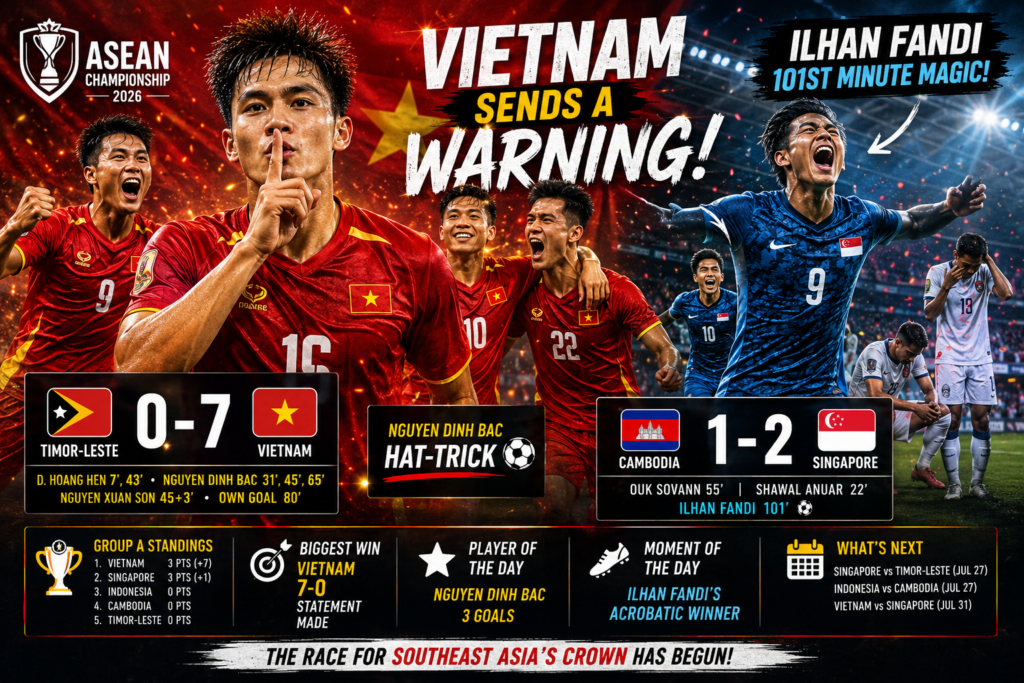
Defending champion Vietnam opened the ASEAN Championship with a ruthless 7-0 victory over Timor-Leste, while Singapore needed Ilhan Fandi’s spectacular 101st-minute winner to beat Cambodia 2-1. Here is what opening day revealed about the title race.

Vietnam began its ASEAN Championship title defense with the authority of a team that has no intention of surrendering its regional crown, crushing Timor-Leste 7-0 as Nguyen Dinh Bac scored an opening-day hat-trick.
The first day of the tournament also produced one of its earliest unforgettable moments. Singapore needed an acrobatic goal from Ilhan Fandi in the 11th minute of stoppage time to escape Phnom Penh with a 2-1 victory over Cambodia.
Both winners collected three points, but their performances created completely different impressions.
Vietnam looked organized, ruthless, and ready for the pressures of defending a championship. Singapore showed resilience and individual quality, although Cambodia exposed weaknesses that stronger Group A opponents may punish.
The ASEAN Championship has only just begun. Vietnam has already established the standard every contender must answer.
TL;DR: ASEAN Championship 2026 Opening Day
- Defending champion Vietnam defeated Timor-Leste 7-0 in Chonburi.
- Nguyen Dinh Bac scored the tournament’s first hat-trick.
- Do Hoang Hen scored twice, while Nguyen Xuan Son also found the net.
- Liam Farrugia’s own goal completed Vietnam’s seven-goal victory.
- Singapore beat Cambodia 2-1 in Phnom Penh.
- Shawal Anuar gave Singapore the lead before Ouk Sovann equalized.
- Ilhan Fandi scored an acrobatic winner in the 101st minute.
- Vietnam leads Group A through its superior goal difference.
- Indonesia has yet to begin its campaign.
ASEAN Championship 2026 Opening-Day Results
| Match | Result | Defining Moment |
|---|---|---|
| Timor-Leste vs Vietnam | 0-7 | Nguyen Dinh Bac completed an opening-day hat-trick. |
| Cambodia vs Singapore | 1-2 | Ilhan Fandi scored an acrobatic winner in the 101st minute. |
The championship features 10 Southeast Asian national teams divided into two groups. Group A contains Vietnam, Singapore, Indonesia, Cambodia, and Timor-Leste. Thailand, Malaysia, the Philippines, Myanmar, and Laos make up Group B.
Each country plays the other teams in its group once, with matches staged on a home-or-away basis. The top two teams from each group qualify for the two-legged semifinals, while the final is also contested over two legs.
Supporters can follow official fixtures, results, tournament news, and match information through the official ASEAN Championship website.
Group A Standings After Opening Day
| Pos. | Team | P | W | D | L | GD | Pts |
|---|---|---|---|---|---|---|---|
| 1 | Vietnam | 1 | 1 | 0 | 0 | +7 | 3 |
| 2 | Singapore | 1 | 1 | 0 | 0 | +1 | 3 |
| 3 | Indonesia | 0 | 0 | 0 | 0 | 0 | 0 |
| 4 | Cambodia | 1 | 0 | 0 | 1 | -1 | 0 |
| 5 | Timor-Leste | 1 | 0 | 0 | 1 | -7 | 0 |
Vietnam and Singapore both collected the required three points, but the seven-goal difference between their opening performances could become significant.
Goal difference may decide qualification if Vietnam, Singapore, and Indonesia finish level on points. Kim Sang-sik’s defending champions have already created a considerable advantage before facing the two strongest challengers in their group.
Vietnam Did More Than Beat Timor-Leste
A 7-0 victory over one of the competition’s less-established teams requires perspective.
Timor-Leste entered the group stage through qualification and was expected to struggle against the defending champion. Vietnam was supposed to win.
The striking part was how completely Kim Sang-sik’s team handled the assignment.
Vietnam did not spend the opening half cautiously studying its opponent. Do Hoang Hen scored after seven minutes, immediately preventing Timor-Leste from settling into a deep defensive structure.
The early breakthrough changed the game. Timor-Leste could no longer focus solely on denying space and protecting a draw. Its players had to move forward more frequently, creating larger gaps for Vietnam’s midfielders and attackers.
Dinh Bac doubled the lead in the 31st minute, curling his strike into the bottom corner of Dylan Niski’s goal.
Vietnam then ended the contest before halftime.
Hoang Hen scored his second, Dinh Bac struck again, and Nguyen Xuan Son found the net during first-half stoppage time. The defending champion entered the interval with a five-goal advantage.
The match had already been won, but Vietnam maintained its intensity.
Dinh Bac completed his hat-trick in the 65th minute after steering home Bui Hoang Viet Anh’s cutback. Liam Farrugia’s own goal then completed the 7-0 rout.
The performance carried many of the qualities associated with successful tournament teams:
- Vietnam scored before its opponent could settle.
- The team punished defensive errors immediately.
- Several attackers contributed goals or assists.
- The players remained focused after establishing a commanding lead.
- The defense protected the clean sheet.
- The result created an important goal-difference advantage.
Major tournament favorites often encounter danger when they allow supposedly weaker opponents to remain level for too long. Confidence grows, frustration spreads, and one counterattack can transform the match.
That kind of vulnerability has shaped many of football’s most memorable surprises, as explored in The Sports Encounter’s feature on historic World Cup upsets.
Vietnam removed that risk within seven minutes.
Nguyen Dinh Bac Takes Control of the Golden Boot Race
Dinh Bac’s hat-trick immediately placed him at the center of the tournament.
The three goals also revealed different parts of his attacking game.
His first showed technical control and finishing quality as he curled the ball beyond Niski. The second rewarded Vietnam’s relentless pressure before halftime. His third came through intelligent movement into the penalty area, where he met Viet Anh’s cutback instead of waiting statically for possession.
That variation matters.
A forward who scores only one type of goal can become easier to contain when the opposition improves. Dinh Bac showed that he could create a finish, react inside the area, and arrive at the right moment during a structured attack.
He also continued searching for goals after the outcome was secure.
That hunger could matter in the individual scoring race. Golden Boot winners often build an early advantage against weaker group opponents before knockout football becomes tighter and chances become harder to create.
ASEAN Championship 2026 Golden Boot Standings
| Player | Team | Goals |
|---|---|---|
| Nguyen Dinh Bac | Vietnam | 3 |
| Do Hoang Hen | Vietnam | 2 |
| Nguyen Xuan Son | Vietnam | 1 |
| Shawal Anuar | Singapore | 1 |
| Ouk Sovann | Cambodia | 1 |
| Ilhan Fandi | Singapore | 1 |
The real test will arrive against Singapore and Indonesia. Those teams should defend space more effectively and force Dinh Bac to operate under greater physical and tactical pressure.
His opening-night performance still gives Vietnam an early individual match-winner and gives the forward a valuable lead in the scoring race.
Do Hoang Hen Adds Another Dimension to Vietnam
Hoang Hen’s two goals were almost as important to Vietnam’s broader title prospects.
The Brazil-born forward opened the scoring and added another before halftime, giving Vietnam a direct presence around Dinh Bac and Xuan Son.
His movement prevented Timor-Leste’s defenders from focusing on one central threat.
Vietnam’s attackers exchanged positions rather than occupying rigid zones. Dinh Bac drifted into scoring areas, Hoang Hen attacked open space, and Xuan Son provided another target closer to goal.
The midfield could therefore supply different runners instead of forcing every attack through the same player.
That balance should concern Vietnam’s stronger rivals.
Regional tournament opponents will often concede possession, block central areas, and wait for counterattacking chances. Multiple scoring threats make that defensive strategy more difficult.
A team dependent on one striker can become predictable. Vietnam’s opening performance suggested that Kim’s attacking threat may come from several areas.
Why Vietnam Already Looks Like the Team to Beat
One victory cannot decide a month-long championship, especially when it comes against Timor-Leste.
Vietnam nevertheless entered as the defending champion and immediately met every expectation attached to that status.
The team showed no visible championship hangover. Its players did not treat the opening fixture as a ceremonial beginning to the campaign. They pressed for control, moved the ball with purpose, and continued attacking after the result had been secured.
Vietnam also understands the competition’s unusual demands.
The home-or-away group format requires national teams to manage travel, recovery, changing stadium environments, and limited preparation windows. The two-legged semifinals and final demand a different tactical approach from a one-match knockout competition.
Experience becomes an advantage because coaches must know when to attack, when to protect an aggregate position, and how to manage emotional momentum over two matches.
The importance of adapting to tournament formats and changing match conditions has been visible across major international competitions, including the tactical issues examined in our analysis of England’s World Cup semifinal defeat against Argentina.
Vietnam possesses recent experience of navigating that pressure. The defending champion knows what the final rounds demand and has begun the new campaign without hesitation.
Vietnam’s Opening-Day Strength Index
This editorial infographic evaluates the major strengths shown during Vietnam’s 7-0 victory. It is an analytical assessment rather than an official tournament metric.
Singapore Won, but Cambodia Exposed Its Problems
Singapore’s 2-1 victory can be interpreted in two ways.
The optimistic view is that the four-time champion found a way to win when the match appeared to be slipping away. Tournament teams need resilience and players capable of producing decisive moments when the collective performance falls short.
The more critical reading is that Singapore struggled to control an opponent it was expected to beat and relied on an extraordinary goal 11 minutes into stoppage time.
Both interpretations are valid.
Shawal Anuar gave Singapore the lead in the 22nd minute, creating the expectation that the Lions would gradually take control.
Cambodia refused to disappear.
Ouk Sovann equalized in the 55th minute, rewarding the home team’s willingness to compete rather than defend passively. As the match entered extended stoppage time, Cambodia appeared close to securing a valuable point.
Ilhan Fandi then produced the moment of the opening day.
Song Ui-young played the ball toward him. Ilhan flicked it into the air, created the angle for an acrobatic attempt, and finished beyond goalkeeper Hul Kimhuy.
The goal combined creativity, technical execution, and nerve.
Attempting such a finish during the 101st minute of a tournament opener carries obvious risk. A failed effort could have ended Singapore’s final attack. Ilhan trusted his instinct and converted one point into three.
Those additional two points may become decisive in a group containing Vietnam and Indonesia.

Ilhan Fandi Delivers the Tournament’s First Viral Moment
Every regional competition needs moments that travel beyond its established audience.
Ilhan’s winner has that potential because the goal contained every element of memorable tournament drama:
- The match was level.
- The goal arrived deep into stoppage time.
- Singapore urgently needed three points.
- The technique was exceptionally difficult.
- The goalkeeper had little chance.
- The result changed the early shape of Group A.
The finish also added another chapter to Singapore’s famous Fandi football family.
Family legacies can create both opportunity and pressure in international football. The emotional complexity of siblings, heritage, and national identity was explored in The Sports Encounter’s feature on football families representing different countries.
Ilhan carries a recognizable surname, but the winning goal belonged entirely to his own imagination and execution.
He understood that a conventional first touch could allow Cambodia’s defenders to close the space. By lifting the ball, he transformed an ordinary pass into an immediate shooting opportunity.
Singapore will need him to remain influential when the opposition becomes stronger. Vietnam should offer less time, while Indonesia may create a more physical contest.
For one night, Ilhan supplied exactly what his country needed.
Cambodia Lost but May Have Found a Path Forward
Cambodia’s defeat should not be dismissed as another routine loss for a developing football country.
The hosts stayed in the contest, recovered after conceding, and reached the 100th minute with a valuable point still within reach.
Ouk Sovann’s equalizer rewarded a team willing to challenge Singapore.
The late defeat will be emotionally difficult because the players had invested enough to believe they had earned a draw. How Cambodia responds now could determine whether its opening display becomes evidence of progress or simply a missed opportunity.
Indonesia provides the next challenge.
Another defeat would place Cambodia close to elimination. A competitive result would strengthen the argument that Singapore’s struggle reflected Cambodian improvement rather than only Singaporean weakness.
Major international tournaments often reveal that smaller football nations can close traditional gaps through organization, fitness, and clear tactical roles. The subject also featured prominently in The Sports Encounter’s FIFA World Cup 2026 curtain-raiser.
Cambodia must now translate encouragement into points.
Why Group A Could Become Complicated
Vietnam’s large victory creates an impression of immediate control, but the group remains competitive.
Indonesia did not play on the opening day and will enter the competition knowing exactly what its main rivals have already achieved.
Singapore faces Timor-Leste next, creating an opportunity to strengthen its goal difference. A narrow victory would keep the Lions behind Vietnam in an area that could eventually decide qualification.
Cambodia must recover emotionally before facing Indonesia. Timor-Leste needs to rebuild defensive confidence after allowing seven goals.
The Vietnam-Singapore meeting could become a direct contest for control of the group, although Indonesia’s results may determine how much either team can afford to lose.
Group A Pressure Index
| Team | Opening Position | Immediate Priority |
|---|---|---|
| Vietnam | Ideal | Maintain intensity against stronger opponents. |
| Singapore | Three points, uneven performance | Beat Timor-Leste decisively and improve match control. |
| Indonesia | Yet to play | Exploit Cambodia’s disappointment and begin strongly. |
| Cambodia | Encouraging performance, painful loss | Convert competitiveness into points. |
| Timor-Leste | Severely damaged | Restore organization and avoid another collapse. |
Group B Now Has a Standard to Answer
Myanmar faces Malaysia before Laos meets Thailand in the opening Group B fixtures.
Thailand remains the competition’s most successful team with seven titles and enters another campaign carrying expectations of reclaiming the regional crown.
Malaysia, the Philippines, Myanmar, and Laos will each approach the group with different ambitions, but Vietnam’s 7-0 result changes the emotional context before any of them has played.
Thailand now knows the defending champion is already functioning at a high level. Malaysia cannot afford a slow beginning against Myanmar. The Philippines will watch the first fixtures before entering the competition.
Coaches may publicly insist that another group’s result has no impact on their plans. Tournament psychology works differently inside dressing rooms. Dominant performances create an early benchmark and force rivals to assess their own readiness.
The dynamics of favoritism, expectations, and tournament pressure appear regularly across The Sports Encounter’s FIFA World Cup 2026 coverage, where several established powers discovered that reputation alone could not guarantee progress.
Opening-Day Power Rankings
These rankings reflect only the teams involved on the first day. They are not a prediction of the eventual champion.
| Rank | Team | Opening-Day Assessment |
|---|---|---|
| 1 | Vietnam | Ruthless, balanced, and already operating like a defending champion. |
| 2 | Singapore | Resilient and dangerous, but less convincing than the result suggests. |
| 3 | Cambodia | Competitive enough to cause problems for stronger teams. |
| 4 | Indonesia | A major contender that has yet to reveal its level. |
| 5 | Timor-Leste | Urgent defensive improvement required after a damaging collapse. |
What Opening Day Taught Us
Vietnam Is Attacking Its Title Defense
Kim Sang-sik’s players did not wait for the competition to develop around them. They imposed themselves immediately.
Goal Difference May Become Decisive
Vietnam already possesses a seven-goal advantage. Singapore will need more than three points when it meets Timor-Leste. It also needs a convincing scoreline.
Cambodia Cannot Be Treated as a Free Victory
The home team pushed Singapore until the final seconds and may disrupt Group A’s expected order.
Singapore Still Has Match-Winners
The collective performance lacked control, but Ilhan produced the individual quality required to change the result.
The Tournament Has Immediate Emotional Energy
A hat-trick, seven-goal rout, comeback, and acrobatic stoppage-time winner gave the championship a powerful opening story.
Individual moments often shape how tournaments are remembered, even when they do not decide the title. The relationship between decisive players and football legacy also drives our analysis of the Messi versus Ronaldo legacy debate.
What Comes Next?
The next fixtures will introduce Group B and clarify whether Vietnam’s opening display represents an early separation from the field.
| Date | Match | What Is at Stake? |
|---|---|---|
| July 25 | Myanmar vs Malaysia | Malaysia faces its first test as a potential semifinal contender. |
| July 25 | Laos vs Thailand | Thailand begins its pursuit of a record-extending eighth title. |
| July 27 | Singapore vs Timor-Leste | Singapore needs goals as well as three points. |
| July 27 | Indonesia vs Cambodia | Indonesia enters while Cambodia tries to recover from its late defeat. |
| July 28 | Philippines vs Myanmar | Early Group B qualification pressure begins to build. |
| July 28 | Malaysia vs Laos | Malaysia plays its second group assignment. |
| July 31 | Vietnam vs Singapore | A potentially decisive contest for control of Group A. |
Vietnam’s next performance will reveal whether it can maintain the same attacking rhythm against stronger resistance. Singapore must improve its control before meeting the defending champion, while Cambodia and Timor-Leste are already under pressure to protect their campaigns.
Readers can follow major tournament stories, international match analysis, and emerging football narratives through The Sports Encounter’s soccer coverage.
Final Verdict
Vietnam could not have designed a more convincing beginning to its ASEAN Championship title defense.
The 7-0 scoreline delivered three points, a substantial goal-difference advantage, and immediate confidence. More importantly, the performance showed that Vietnam’s attack does not depend on one player.
Dinh Bac scored three, Hoang Hen added two, Xuan Son contributed, and Viet Anh helped create another. The defending champion played with the clarity of a squad that understands the tournament and accepts the pressure attached to its status.
Singapore’s opening story was different.
The Lions did not dominate Cambodia and will need greater control against stronger opponents. Tournament football often rewards teams that survive difficult matches, however, and Ilhan Fandi’s extraordinary winner converted an uncertain display into three valuable points.
Cambodia left with no points but gained respect. Timor-Leste left with urgent defensive questions.
The first day therefore produced more than two winners.
Vietnam established the tournament’s opening benchmark. Singapore delivered its first unforgettable moment. Cambodia showed that Group A may resist easy predictions.
Thailand, Indonesia, Malaysia, and the other contenders must now respond.
FAQs
Who won on the opening day of the ASEAN Championship 2026?
Vietnam defeated Timor-Leste 7-0, while Singapore beat Cambodia 2-1.
Who scored a hat-trick for Vietnam?
Nguyen Dinh Bac scored three goals in Vietnam’s opening victory over Timor-Leste.
Who else scored for Vietnam against Timor-Leste?
Do Hoang Hen scored twice, Nguyen Xuan Son added another goal, and Liam Farrugia scored an own goal.
Who scored Singapore’s winning goal against Cambodia?
Ilhan Fandi scored an acrobatic winner in the 11th minute of second-half stoppage time.
Who scored Singapore’s opening goal?
Shawal Anuar gave Singapore the lead in the 22nd minute.
Who equalized for Cambodia?
Ouk Sovann scored Cambodia’s equalizer in the 55th minute.
Which teams are in ASEAN Championship Group A?
Group A contains Vietnam, Singapore, Indonesia, Cambodia, and Timor-Leste.
Which teams are in Group B?
Group B includes Thailand, Malaysia, the Philippines, Myanmar, and Laos.
How many teams qualify for the ASEAN Championship semifinals?
The top two teams from each group advance to the two-legged semifinals.
Why could Vietnam’s seven-goal win be important later?
Vietnam’s plus-seven goal difference gives it an early advantage if two or more Group A teams eventually finish level on points.
When do Vietnam and Singapore play each other?
Vietnam and Singapore are scheduled to meet on July 31, 2026, in a match that could influence the top position in Group A.
Where can supporters follow official ASEAN Championship updates?
Official schedules, tournament news, match information, and results are available through the ASEAN Championship’s official competition portal.