

Liam Livingstone Fights Hard, But Manchester Super Giants Beat London Spirit by 7 Runs
Liam Livingstone crossed 1,000 Hundred runs and produced a remarkable all-round performance, but Tim Seifert and Sonny Baker helped Manchester Super Giants defeat London Spirit by seven runs at Lord’s.

Liam Livingstone crossed 1,000 career runs in The Hundred, took two wickets and dragged London Spirit to the edge of a remarkable victory. Manchester Super Giants still found a way to leave Lord’s with the points.
Sonny Baker defended nine runs from the final two balls and dismissed James Coles from the last delivery as Manchester Super Giants defeated London Spirit by seven runs in Match 3 of The Hundred Men’s Competition 2026.
Super Giants posted 138 for nine after Tim Seifert struck 67 from 45 balls. Spirit appeared to be drifting out of the contest before Livingstone’s 69 from 40 deliveries brought the chase back to life in front of 23,847 spectators.
The London captain also delivered an outstanding 20-ball spell, taking two wickets for only 14 runs. He received the Meerkat Match Hero award despite finishing on the losing side.
His individual brilliance could not erase Spirit’s slow beginning. They reached only 51 for three after 46 balls and eventually finished on 131 for six from their full allocation.
For Manchester, the result carried immediate historic value. It was the men’s team’s first victory under the Manchester Super Giants identity after the former Manchester Originals franchise was renamed ahead of the 2026 season.
Follow The Sports Encounter’s Cricket Hub for more match reports, tournament updates, and player analysis.
London Spirit vs Manchester Super Giants Match Summary
| Match detail | Information |
|---|---|
| Competition | The Hundred Men’s Competition 2026 |
| Match | Match 3 |
| Date | July 23, 2026 |
| Venue | Lord’s, London |
| Toss | London Spirit elected to field |
| Manchester Super Giants | 138/9 from 100 balls |
| London Spirit | 131/6 from 100 balls |
| Result | Manchester Super Giants won by 7 runs |
| Match Hero | Liam Livingstone, 69 and 2/14 |
| Top scorer for Manchester | Tim Seifert, 67 from 45 balls |
| Best Manchester bowling | Gus Atkinson 2/15, Sonny Baker 2/29 |
| Attendance | 23,847 |
| Points | Manchester Super Giants 4, London Spirit 0 |
TL;DR
- Manchester Super Giants defeated London Spirit by seven runs at Lord’s.
- Tim Seifert anchored Manchester’s 138 for nine with 67 from 45 balls.
- Seifert was given a costly reprieve when he had scored 21.
- Liam Livingstone took two for 14 from 20 balls, including 10 dot balls.
- Livingstone then scored 69 from 40 deliveries, hitting four fours and five sixes.
- His fourth run took him past 1,000 career runs in The Hundred.
- Spirit were 51 for three after 46 balls and allowed the required rate to rise too sharply.
- Livingstone and Dewald Brevis added 68 for the fourth wicket.
- Gus Atkinson conceded only 15 runs from 20 balls and delivered 12 dot balls.
- Sonny Baker dismissed Livingstone on ball 98 and Coles on ball 100.
- Manchester completed a men’s and women’s double over London Spirit on the same day.
- The result gave the renamed Manchester franchise its first men’s victory as the Super Giants.
Tim Seifert Holds Manchester Together After Markram Struggles
Aiden Markram’s first innings as Manchester Super Giants captain began with an uncomfortable examination from London Spirit’s pace attack.
Adam Milne and David Willey used the movement available from a slightly uneven Lord’s surface. Markram struggled to release the pressure and made only one run from 10 balls.
Spirit challenged an early not-out decision through DRS, although the review was unsuccessful. Milne eventually completed the dismissal by trapping Markram lbw on the 18th delivery.
Manchester had reached 16 for one, but nearly half of those deliveries had already disappeared.
Seifert prevented the innings from becoming trapped in Markram’s struggle. He attacked whenever the bowlers missed their lengths and ensured Super Giants finished the 25-ball powerplay on 26 for one.
It was a modest score, although the surface had already shown that timing would not come easily.
Buttler Gives Seifert Brief Support
Jos Buttler brought immediate intent to the crease.
The England wicketkeeper struck one four and one six in his 16 from 11 balls, helping Seifert move Manchester towards a stronger scoring rate. Their partnership carried the total to 65 before Adam Zampa bowled Buttler on the 43rd delivery.
Seifert had taken control by then. His fifty arrived from only 29 balls and included four fours and three sixes.
The acceleration was particularly valuable because Manchester’s middle and lower order would later struggle to maintain his tempo.
Seifert’s Reprieve Changes the Match
Spirit had an opportunity to remove Seifert when he had scored 21, but the chance went down.
That error became more expensive with every boundary.
Seifert added another 46 runs after the reprieve. Manchester eventually won by seven, making the missed opportunity one of the clearest turning points in the contest.
Heinrich Klaasen briefly added further momentum with 17 from 11 balls. His innings contained a four and a six before Willey had him caught by Livingstone.
Manchester were 105 for three after 68 deliveries and appeared capable of moving beyond 150.
Spirit responded with their best passage of the night.
Livingstone’s Bowling Leads Manchester’s Late Collapse
Zampa removed Leus du Plooy for six, while Tom Moores was run out without scoring. Manchester slipped from 105 for three to 116 for five in nine balls.
Livingstone then took command of the middle and closing phases.
The Spirit captain varied his pace, attacked the stumps and refused to give Manchester’s lower order room to swing freely. Liam Dawson was bowled for nine, and Gus Atkinson was caught by Jamie Overton for six.
Livingstone completed his full 20-ball allocation with two wickets for 14 runs. Half of his deliveries were dots, and he conceded only 0.70 runs per ball.
Milne was similarly restrictive, returning one for 11 from 15 balls with nine dots. Those two spells gave away only 25 runs from 35 deliveries.
Seifert’s dismissal for 67 on ball 87 removed Manchester’s last established batter. The Super Giants lost six wickets for 33 runs after reaching 105 for three, eventually closing on 138 for nine.
Two run-outs in the closing phase underlined Spirit’s improved fielding. The chase looked achievable, but only if their top order managed the new ball better than Manchester had.
Gus Atkinson Leaves Spirit Chasing the Chase
Spirit’s pursuit began with the same discomfort Manchester had experienced.
Lhuan-dre Pretorius struck one four and one six but could not settle. Atkinson removed him for 12 from 13 balls, with Leus du Plooy taking the catch.
Josh Tongue then dismissed James Rew for a two-ball duck. Spirit were 14 for two after 16 deliveries and ended the 25-ball powerplay on 24 for two.
Atkinson’s early control became even more valuable as the match progressed. His 20 balls cost only 15 runs, and he delivered a remarkable 12 dot balls.
In a chase requiring 139, those dots effectively removed more than one-tenth of Spirit’s entire innings.
Kiran Carlson attempted to rebuild, but his 19 from 19 balls did little to reduce the growing pressure. Dawson bowled him on ball 46 with Spirit on 51 for three.
They needed another 88 runs from 54 deliveries.
The required rate had climbed from 1.39 runs per ball at the start to approximately 1.63. Spirit still had wickets available, but they had surrendered too much time.
Livingstone and Brevis Reopen a Match That Looked Lost
Livingstone refused to let the chase disappear quietly.
He began with controlled aggression, choosing his moments rather than immediately attempting to repair the required rate through desperate hitting. Dewald Brevis provided support, although his 22 from 23 balls was more functional than explosive.
At the strategic timeout, Spirit were 69 for three after 60 balls. Livingstone had 28, Brevis had eight, and another 70 runs were needed from 40 deliveries.
Manchester still held a commanding position.
The next phase changed the emotional direction of the match.
Livingstone attacked Noor Ahmad, whose 20 balls eventually cost 36 runs. The Spirit captain cleared the boundary five times and repeatedly found areas Manchester had struggled to protect.
Brevis played a quieter role, rotating the strike and allowing Livingstone to target the favorable matchups. Their fourth-wicket partnership produced 68 runs and revived a crowd that had started to accept defeat.
Spirit reached 100 from 81 balls. They now needed 39 from 19.
It was difficult, but Livingstone’s presence made it believable.
Livingstone Passes 1,000 Hundred Runs
Livingstone entered the match with 996 career runs in The Hundred. He needed only four to reach the 1,000-run landmark.
The captain finished the evening with 1,065 career runs in the competition after adding 69. Before the 2026 season, he stood sixth on the tournament’s all-time men’s run list and held the record for the most sixes with 71, according to Lord’s Cricket Ground’s announcement of his Spirit captaincy.
His five sixes against Manchester extended that record to 76.

Livingstone had spent the first five seasons of The Hundred with Birmingham Phoenix. His first innings for Spirit showed why the London franchise trusted him with its captaincy.
His fifty came from 32 balls, with three fours and four sixes. By the end of the innings, he had scored 69 of Spirit’s 131 runs, accounting for 52.7 percent of their total.
Atkinson Removes Brevis at the Critical Moment
Brevis fell on the 92nd ball with Spirit on 119.
The South African attempted to force Atkinson back down the ground but offered the bowler a return catch. Manchester had broken the partnership, yet the match remained alive.
Spirit required 20 from eight balls.
Livingstone continued attacking and reduced the equation to nine from the final two deliveries. It was a remarkable position considering Spirit had needed 70 from the last 40.
Baker now had to bowl to the most dangerous player on the field.
The young fast bowler found the delivery Manchester needed. He pitched the ball full enough to attack the stumps and bowled Livingstone for 69 on ball 98.
The captain’s dismissal drained the noise from Lord’s.
Jamie Overton collected a single, leaving James Coles to face the final delivery with eight required. Coles attempted to flick Baker towards the leg-side boundary, but Tom Moores completed the catch at deep backward square.
Baker finished with two for 29. Both wickets arrived inside the final three balls, and both were essential.
Where London Spirit Lost the Match
Livingstone’s dismissal attracted the drama, but Spirit’s defeat had developed much earlier.
| Match phase | London Spirit position | Runs required | Balls remaining |
|---|---|---|---|
| Start of chase | 0/0 | 139 | 100 |
| End of powerplay | 24/2 | 115 | 75 |
| Carlson dismissed | 51/3 | 88 | 54 |
| Strategic timeout | 69/3 | 70 | 40 |
| 100 reached | 100/3 | 39 | 19 |
| Brevis dismissed | 119/4 | 20 | 8 |
| Livingstone dismissed | 130/5 | 9 | 2 |
Spirit used 46 percent of their innings to score only 51 runs. That left Livingstone and Brevis trying to recover at more than 1.6 runs per delivery on a pitch where both teams had struggled for fluency.
The decisive bowling numbers tell the same story.
Atkinson and Dawson combined for three wickets and conceded only 38 runs from 40 balls. They delivered 21 dots between them.
Tongue added another six dot balls, while Baker produced nine.
Manchester gave away 29 runs from Baker’s allocation and 36 from Noor’s, but Spirit could not compensate for the pressure created by the other three bowlers.
Livingstone acknowledged the problem afterward.
“We got ourselves too far behind the run rate.”
He also described the surface as slightly up-and-down and believed 138 and 131 were both close to par scores in the conditions.
Livingstone’s Rare Match Hero Award in Defeat
The decision to name Livingstone Match Hero despite Spirit’s loss reflected the scale of his performance.
His bowling figures of two for 14 were the most economical of the match among bowlers who delivered a full 20 balls. With the bat, he scored more than three times as many runs as Spirit’s next-highest contributor.
Livingstone also assisted in the final-ball run-out of Josh Tongue during Manchester’s innings.
Seifert’s 67 remained the performance that separated the teams. His innings gave Manchester enough runs to survive their late collapse, while his reprieve on 21 proved costly.
Livingstone was the best all-round player on the field. Seifert produced the innings that ultimately delivered victory.
Both statements can be true.
Manchester Super Giants Begin Their New Identity With a Win
The 2026 season represents a major reset for The Hundred.
Manchester Originals became Manchester Super Giants following the arrival of new investment and IPL-linked ownership. Justin Langer also moved from London Spirit to become Manchester’s head coach, adding another layer to the victory at Lord’s.
His first men’s match under the Super Giants identity came against the side he coached in 2025.
The result therefore carried more meaning than an ordinary opening win. Manchester showed that their redesigned squad could absorb a lower-order collapse, defend a competitive total and remain composed when one batter threatened to take the match away.
Spirit are also operating with a significantly rebuilt group under Andy Flower. Some rust was visible in their top-order timing, dropped chance and early chase management.
Readers can revisit the first two matches through our reports on Nicholas Pooran’s 22-ball assault for MI London and Phil Salt’s controlled chase for Welsh Fire.
Manchester Complete a Lord’s Double
Manchester’s women had already defeated London Spirit by seven wickets earlier in the day.
Ryana MacDonald-Gay took four wickets as Spirit were bowled out for 80. Super Giants reached 86 for three in only 59 balls, winning with 41 deliveries remaining.
The men’s seven-run victory completed a same-day sweep and earned the franchise eight combined points.
Under the official 2026 Hundred competition rules, every victory earns four points, while ties and abandoned matches produce two points for each team.
The women made their result emphatic. The men had to survive Livingstone.
Together, they gave Manchester Super Giants a near-perfect opening statement under their new name.
Early Men’s Hundred 2026 Points Picture
| Team | Played | Won | Lost | Points | NRR |
|---|---|---|---|---|---|
| MI London | 1 | 1 | 0 | 4 | +1.421 |
| Manchester Super Giants | 1 | 1 | 0 | 4 | +0.350 |
| Welsh Fire | 1 | 1 | 0 | 4 | +0.291 |
| Birmingham Phoenix | 0 | 0 | 0 | 0 | 0.000 |
| Trent Rockets | 0 | 0 | 0 | 0 | 0.000 |
| Southern Brave | 1 | 0 | 1 | 0 | -0.291 |
| London Spirit | 1 | 0 | 1 | 0 | -0.350 |
| SunRisers Leeds | 1 | 0 | 1 | 0 | -1.421 |
Manchester’s seven-run margin moved them above Welsh Fire on net run rate, although MI London retained the strongest early NRR after their rapid opening victory.
Final Verdict
Manchester Super Giants won because Seifert made Spirit pay for a missed chance, Atkinson denied the chase early momentum, and Baker held his nerve when the entire match came down to two deliveries.
Livingstone gave Lord’s its most memorable individual performance of The Hundred 2026 so far.
He crossed 1,000 tournament runs, extended his six-hitting record, delivered the best bowling spell of the match and scored 69 while everyone around him struggled. His innings transformed an increasingly hopeless chase into a contest decided on the final ball.
Spirit will take encouragement from their captain’s form and the control shown by Milne, Livingstone and Zampa. Their top-order tempo and fielding must improve quickly.
Manchester leave Lord’s with four points, their first men’s victory as the Super Giants and proof that they can defend under extreme pressure.
Livingstone owned the evening’s defining performance. Seifert and Baker ensured Manchester owned the result.
FAQs
Who won London Spirit vs Manchester Super Giants in The Hundred 2026?
Manchester Super Giants defeated London Spirit by seven runs. They scored 138 for nine before restricting Spirit to 131 for six.
Who was named Player of the Match?
Liam Livingstone received the Meerkat Match Hero award after scoring 69 from 40 balls and taking two wickets for 14 runs.
How many runs did Tim Seifert score?
Tim Seifert made 67 from 45 deliveries, hitting six fours and three sixes.
Did Liam Livingstone pass 1,000 runs in The Hundred?
Yes. Livingstone began the match with 996 career runs and crossed 1,000 during his innings of 69.
How many sixes did Livingstone hit?
He struck five sixes and four fours during his 40-ball innings.
What were Gus Atkinson’s bowling figures?
Atkinson took two wickets for 15 runs from 20 balls and delivered 12 dot balls.
How many points did Manchester Super Giants receive?
Manchester received four points for the victory. London Spirit received zero.







Breaking News
Clarke, Smeed Power Birmingham Phoenix Past Trent Rockets in 418-Run Hundred Thriller
Joe Clarke and Will Smeed shared a 104-run opening stand before Birmingham Phoenix survived powerful innings from Finn Allen, Ben Duckett, and Tom Banton to defeat Trent Rockets by 10 runs in a 418-run thriller at Edgbaston.

Joe Clarke struck 68 from 33 balls and shared a 104-run opening partnership with Will Smeed as Birmingham Phoenix defeated Trent Rockets by 10 runs in a breathless Match 4 of The Hundred Men’s Competition 2026 at Edgbaston.
Phoenix piled up 214 for four from their 100 balls, the kind of total that usually settles a contest long before the final set. Trent Rockets refused to disappear. Finn Allen, Ben Duckett and Tom Banton kept the chase alive, pushing their side to 204 for seven and forcing Phoenix to defend almost every run of their imposing total.
The match produced 418 runs, 27 sixes and two powerplays of 54 without loss. It was aggressive even by the compressed standards of The Hundred, but Birmingham handled the decisive moments more calmly. Scott Currie and Usman Tariq claimed two wickets each, while Phoenix repeatedly found breakthroughs whenever the Rockets looked capable of taking control.
Clarke was named the Meerkat Match Hero after scoring 68 from 33 deliveries and taking two catches behind the stumps. His innings contained seven fours and four sixes and gave Phoenix the freedom to keep attacking throughout the remaining 67 balls.
Fans can follow the wider tournament through The Sports Encounter’s cricket coverage, including the report on Phil Salt guiding Welsh Fire past Southern Brave and Liam Livingstone’s 69 against Manchester Super Giants.
TL;DR
- Birmingham Phoenix defeated Trent Rockets by 10 runs at Edgbaston.
- Phoenix scored 214 for four, while the Rockets replied with 204 for seven.
- Joe Clarke made 68 from 33 balls and took two catches.
- Will Smeed struck 51 from 28 balls in a 104-run opening partnership with Clarke.
- Rehan Ahmed added 48 from 25 deliveries, including five sixes.
- Finn Allen scored 43 from 17 balls for Trent Rockets.
- Ben Duckett made 49 from 25, while Tom Banton hit 67 from 32.
- Scott Currie and Usman Tariq took two wickets each for Phoenix.
- Phoenix collected four points, while Trent Rockets left Edgbaston empty-handed.
Birmingham Phoenix vs Trent Rockets Match Summary
| Match Detail | Information |
|---|---|
| Competition | The Hundred Men’s Competition 2026 |
| Match | Birmingham Phoenix vs Trent Rockets, Match 4 |
| Date | July 24, 2026 |
| Venue | Edgbaston, Birmingham |
| Toss | Trent Rockets won the toss and fielded |
| Birmingham Phoenix | 214/4 from 100 balls |
| Trent Rockets | 204/7 from 100 balls |
| Result | Birmingham Phoenix won by 10 runs |
| Match Hero | Joe Clarke, 68 from 33 balls and two catches |
| Points | Birmingham Phoenix 4, Trent Rockets 0 |
Clarke and Smeed Turn the Powerplay Into a Warning
Trent Rockets chose to field first, perhaps expecting their experienced bowling attack to control the early tempo. Craig Overton, Matt Henry, Mohammad Amir, Mitchell Santner, Lewis Gregory and Calvin Harrison offered a broad range of pace, swing and spin.
Clarke and Smeed made that variety almost irrelevant during the opening phase.
Phoenix reached 54 without loss from the first 25 balls. Clarke supplied most of the initial damage, racing to 32 while Smeed contributed 18 during the first 50-run stand. The pair ran well when the boundary was protected and attacked whenever the bowlers missed their lengths.
Clarke’s fifty arrived from only 24 balls. Seven fours and two sixes took him to the landmark, but his innings was more controlled than the boundary count suggests. He rarely appeared rushed. His head remained still, his base stayed balanced, and he picked up length early enough to attack both pace and spin.
Phoenix reached 100 from 44 balls without losing a wicket. At the strategic timeout after 45 deliveries, they were 101 for none, with Clarke on 67 and Smeed on 34.
The opening partnership eventually ended at 104 from 49 balls when Calvin Harrison removed Clarke for 68. Tom Banton completed the catch, but the Rockets had already surrendered more than half the deliveries while taking no wickets.
Clarke later said Phoenix’s top order had been given a clear license to attack because of the depth behind them.
“We’ve got license at the top of the order with our strength and depth. Smeedy played unbelievably well.”
That freedom shaped the innings. Phoenix did not treat the loss of Clarke as a signal to slow down. They continued searching for boundaries because the batting order still contained Rehan Ahmed, Donovan Ferreira, Mitchell Owen, Sean Dickson and Laurie Evans.
Will Smeed Converts Support Into a Fifty
Smeed’s role changed as the partnership developed.
Clarke dominated the first half, allowing Smeed to settle without forcing high-risk strokes. Once Clarke departed, Smeed assumed greater responsibility and reached his fifty from 27 balls.
His 51 from 28 deliveries included two fours and three sixes. The boundary distribution showed that his innings relied heavily on clean aerial striking rather than repeated ground shots.
Smeed’s ability to stay with Clarke for almost half the innings gave Phoenix tactical security. The pair combined aggression with low dismissal risk, which is especially valuable in a 100-ball match. A team can recover from an early wicket, but repeated rebuilding periods consume too much of the innings.
Harrison finally dismissed Smeed with Phoenix on 134 after 72 balls. The leg-spinner finished as Trent Rockets’ most effective bowler, taking two for 27 from 20 deliveries and conceding only 1.35 runs per ball.
His spell prevented Phoenix from moving beyond 225 or 230. The wider bowling effort around him, however, lacked the same control.
Rehan Ahmed’s Five Sixes Break the Middle-Overs Pattern
Rehan Ahmed entered with a platform already established, but his contribution remained essential. Phoenix had scored rapidly, yet they still needed someone to carry that tempo through the final quarter.
Rehan responded with 48 from 25 balls at a strike rate of 192. His innings included two fours and five sixes, making him Phoenix’s most productive six-hitter.
His approach differed from Clarke’s. Clarke accumulated heavily through boundaries along the ground before adding four sixes. Rehan looked to clear the rope whenever the ball entered his preferred arc.
The innings gained further momentum when Donovan Ferreira joined him. Their third-wicket partnership added 50 runs from only 19 balls, carrying Phoenix from a strong position into territory that demanded an exceptional chase.
Ferreira finished unbeaten on 22 from nine deliveries, hitting three sixes. His strike rate of 244.44 reflected the exact role Phoenix needed from their captain. He did not require time to adjust and immediately targeted the shorter scoring options.
The importance of multi-skilled players such as Rehan has become a wider discussion in modern franchise cricket. The Sports Encounter recently examined whether the IPL Impact Player rule is limiting the development of genuine all-rounders. Rehan’s innings offered a reminder of the tactical value created by a cricketer who can bat aggressively and still provide a bowling option.
Phoenix Score 64 From Their Final 23 Balls
Phoenix reached 150 from 77 deliveries. Their final 23 balls produced another 64 runs.
That acceleration decided the match.
Rehan and Ferreira carried the total to 197 before Mohammad Amir removed Rehan on the 94th ball. Finn Allen completed the catch, giving Amir figures of one for 43 from his 20 deliveries.
Mitchell Owen then struck a six during his three-ball stay before falling to Lewis Gregory for six. Sean Dickson faced the final two balls and scored eight, including a six, as Phoenix closed on 214 for four.
Matt Henry conceded 48 from 15 balls, while Gregory went for 42 from 15. Those two spells cost 90 runs from 30 deliveries, creating pressure that Harrison’s economical spell could not fully repair.
Craig Overton was outstanding with the new ball, conceding only nine runs from 10 deliveries and producing six dots. The contrast between Overton’s control and the punishment absorbed elsewhere became one of the clearest features of the innings.
How Birmingham Phoenix Built 214
| Batter | Runs | Balls | Fours | Sixes | Strike Rate |
|---|---|---|---|---|---|
| Joe Clarke | 68 | 33 | 7 | 4 | 206.06 |
| Will Smeed | 51 | 28 | 2 | 3 | 182.14 |
| Rehan Ahmed | 48 | 25 | 2 | 5 | 192.00 |
| Donovan Ferreira | 22* | 9 | 0 | 3 | 244.44 |
| Mitchell Owen | 6 | 3 | 0 | 1 | 200.00 |
| Sean Dickson | 8* | 2 | 0 | 1 | 400.00 |
Allen and Duckett Refuse to Treat 215 as Impossible
Trent Rockets needed 215 from 100 balls, requiring more than two runs per delivery from the beginning.
Finn Allen and Ben Duckett responded with the only sensible approach available. They attacked immediately.
Rockets matched Phoenix’s powerplay score exactly, reaching 54 without loss from 25 balls. Allen supplied the more violent hitting. He struck 43 from 17 deliveries, including six fours and three sixes, and scored at a strike rate of 252.94.
The opening pair reached 50 from only 22 balls. Allen contributed 33 of those runs, giving the Rockets enough early momentum to make the target appear reachable.
Phoenix needed a wicket before the opening stand moved into the same territory created by Clarke and Smeed.
Usman Tariq provided it on the 29th ball. Allen was caught by Scott Currie with the score on 65.
The dismissal mattered because it interrupted the Rockets’ fastest scorer before he could occupy another 10 or 15 deliveries. Allen had already placed Phoenix under pressure. A longer stay could have forced Ferreira to alter his bowling plans much earlier.
Duckett continued attacking after Allen’s departure. His 49 came from 25 balls, with six fours and two sixes. He fell one run short of a half-century when Currie found the breakthrough and Clarke took the catch behind the stumps.
At 102 for two after 48 balls, Trent Rockets remained firmly in the match. They required 113 from the final 52 deliveries, and Tom Banton had begun to settle.
The chase was alive. Phoenix’s 214 had created margin, but it had not created safety.
Tom Banton Keeps the Rockets’ Chase Moving
Tom Banton walked in after Finn Allen’s dismissal with Trent Rockets still ahead of the rate required to remain competitive. Ben Duckett was already established, and the scoreboard pressure had yet to become overwhelming.
Banton needed only a brief settling period. He scored eight from his first few deliveries before taking greater responsibility following Duckett’s departure.
Duckett fell for 49 from 25 balls when Scott Currie found the edge and Joe Clarke completed the catch. Trent Rockets were 102 for two after 48 deliveries, almost level with Birmingham Phoenix at the corresponding stage of their innings.
The similarity ended there.
Phoenix had reached 104 without loss before Clarke became their first dismissal. Rockets had already lost Allen and Duckett, the two batters who had supplied most of their early momentum.
That difference in wickets preserved became increasingly important as the chase moved into its second half.
Banton continued to attack. His fifty arrived from 26 balls, with four fours and three sixes. He found enough clean contact against pace and spin to prevent the asking rate from moving completely out of reach.
His eventual 67 from 32 deliveries included four fours and five sixes. Only Clarke scored more runs in the match, while Banton’s strike rate of 209.37 reflected the level of aggression required in a chase of 215.
Phoenix Break the Chase Through the Middle
The decisive passage began after Duckett’s dismissal.
Tim David arrived with the power to transform a chase, but Usman Tariq removed him for two from three balls. Clarke took his second catch behind the stumps, leaving Trent Rockets at 111 for three after 55 deliveries.
Sam Billings then faced the difficult task of rebuilding without allowing the required rate to climb. He managed 12 from nine balls before Ben Dwarshuis dismissed him, with Scott Currie taking the catch.
At 127 for four after 66 balls, the Rockets required 88 from the final 34 deliveries.
That equation remained possible in a match where batters had repeatedly cleared the boundary, but the batting side needed a substantial partnership. Banton required someone to stay with him and share the boundary-hitting burden.
Mitchell Santner could not provide that support. He scored seven from eight balls before a sharp combination between Donovan Ferreira and Dwarshuis ran him out.
Santner’s innings consumed deliveries without reducing the required rate. By the time he departed at 161 for five after 85 balls, Trent Rockets needed 54 from 15.
Banton was still there, but Phoenix had forced him to chase an increasingly unforgiving equation with the lower order.
Why Usman Tariq’s Two Wickets Mattered
Usman Tariq finished with two for 36 from his 20 deliveries. His figures were not the most economical of the innings, but the identities and timing of his wickets made his spell central to the result.
He first removed Finn Allen after the opener had raced to 43 from 17 balls. Allen was the batter most likely to turn 215 into a manageable target before the halfway stage.
Tariq later dismissed Tim David for two. David’s power and experience made him one of the most dangerous players in the Rockets’ middle order, particularly with Banton already scoring freely.
Taking out both players prevented Trent Rockets from building a second major partnership after the 65-run opening stand.
Tariq also delivered three dot balls and conceded 1.80 runs per ball. In a match where the combined scoring rate exceeded two runs per delivery, that economy carried additional value.
Scott Currie Wins Two Major Matchups
Scott Currie took two for 40, dismissing Duckett and Banton.
Those wickets removed the two batters who came closest to carrying the chase. Duckett fell one run short of his fifty, while Banton departed with six balls remaining and the Rockets still needing 29.
Currie’s overall figures included only two dot balls, which showed how heavily he came under attack. He still found ways to dismiss established batters rather than settling for damage limitation.
His fielding contribution was equally important. Currie caught Allen, Billings, and later remained involved throughout the most demanding phase of the innings.
Phoenix did not dominate with the ball. They conceded 204 and watched three Rockets batters score at strike rates above 196. Their success came from taking wickets at moments when partnerships threatened to make the chase sustainable.
Banton’s Dismissal Ends the Real Contest
Trent Rockets entered the final 15 balls needing 54 runs.
Banton kept swinging. Lewis Gregory joined him but made only one from two balls before Mitchell Owen completed a caught-and-bowled dismissal.
Banton fell on the 94th delivery, caught by Sean Dickson off Currie. The score had reached 186 for six.
His dismissal left the Rockets needing 29 runs from six balls.
Calvin Harrison created a final burst of noise by hitting two sixes from the last two deliveries. His unbeaten 12 from two balls pushed the final total beyond 200, but the result had already been decided.
The final ball disappeared over the bowler’s head for six. Trent Rockets finished on 204 for seven, 10 runs short of the target.
That final margin reflected Phoenix’s late batting surge. Ferreira, Owen, and Dickson had combined for 36 runs from 14 balls. Without those contributions, the Rockets’ chase may have ended differently.
Trent Rockets Batting Scorecard
| Batter | Runs | Balls | Fours | Sixes | Strike Rate |
|---|---|---|---|---|---|
| Ben Duckett | 49 | 25 | 6 | 2 | 196.00 |
| Finn Allen | 43 | 17 | 6 | 3 | 252.94 |
| Tom Banton | 67 | 32 | 4 | 5 | 209.37 |
| Tim David | 2 | 3 | 0 | 0 | 66.66 |
| Sam Billings | 12 | 9 | 2 | 0 | 133.33 |
| Mitchell Santner | 7 | 8 | 0 | 0 | 87.50 |
| Lewis Gregory | 1 | 2 | 0 | 0 | 50.00 |
| Craig Overton | 4* | 3 | 0 | 0 | 133.33 |
| Calvin Harrison | 12* | 2 | 0 | 2 | 600.00 |
The Numbers That Defined the Match
- The two teams combined for 418 runs from 200 balls.
- Birmingham Phoenix scored at 2.14 runs per ball.
- Trent Rockets scored at 2.04 runs per ball.
- Phoenix hit 17 sixes, while Trent Rockets struck 12.
- Both teams scored 54 without loss during their 25-ball powerplays.
- Clarke and Smeed added 104 from 49 balls for the first wicket.
- Allen and Duckett added 65 from 29 balls for the Rockets.
- Phoenix scored 64 runs from their final 23 balls.
- Rockets lost five wickets between the 48th and 98th deliveries.
- Six batters scored at strike rates above 200.
- Clarke reached fifty from 24 balls, Smeed from 27, and Banton from 26.
- Calvin Harrison returned the best bowling figures of the match with two for 27.
Where Trent Rockets Lost the Match
The decision to field first did not fail because Trent Rockets lacked wicket-taking options. It failed because too many bowlers conceded runs at an unsustainable rate.
Craig Overton and Calvin Harrison delivered 30 balls for only 36 runs between them. The remaining 70 balls cost 178.
Matt Henry conceded 48 from 15 deliveries, while Lewis Gregory gave up 42 from 15. Mohammad Amir allowed 43 from 20, although he did remove Rehan Ahmed during the final phase.
The Rockets’ chase showed that 215 was not beyond reach on the surface. Their top three scored 159 runs from 74 balls and struck 16 boundaries and 10 sixes between them.
The middle order supplied only 22 runs from the next 25 balls faced by David, Billings, Santner, Gregory, and Overton.
That slowdown placed too much responsibility on Banton. Phoenix had received contributions from every batter who came to the crease. Trent Rockets depended almost entirely on their top three.
Joe Clarke Sets the Tone and Finishes the Job
Clarke’s award reflected more than his 68.
His innings gave Phoenix control of the match before the first wicket fell. He reached his half-century inside the powerplay and ensured Smeed could build his own innings without carrying the early scoring burden.
Clarke then contributed two catches during the chase, removing Duckett and David. Both dismissals arrived while the Rockets were trying to build partnerships around Banton.
Speaking after the match, Clarke acknowledged that the strength of Trent Rockets’ batting meant Phoenix could not relax despite defending 214.
“With the class that’s in their lineup, the game was never done. Credit to our boys, they stayed calm and executed well.”
He also credited the Edgbaston crowd and highlighted the importance of beginning the tournament strongly before Phoenix entered a run of away fixtures.
“You need to have a strong start, and the crowd were amazing tonight. We’ve got a couple of games away, and hopefully we can come back in a good position near the end of the group stages.”
What the Result Means for Birmingham Phoenix
Birmingham Phoenix collected four points from their opening match and moved into the early group-stage picture alongside the other first-round winners.
The performance gave Phoenix several encouraging signs beyond the result.
Clarke and Smeed established a dangerous opening partnership. Rehan showed that he can provide serious middle-order power, while Ferreira’s late acceleration demonstrated the depth Clarke referenced after the match.
The bowling figures were expensive, but Phoenix maintained composure under pressure. Currie, Tariq, Dwarshuis, and Owen all took wickets, spreading responsibility across the attack.
Phoenix will next travel to Emirates Old Trafford to face Manchester Super Giants on July 26 before visiting Southern Brave on July 30. Their next home appearance is scheduled against Welsh Fire on August 1.
Supporters can follow the competition through the The Sports Encounter Cricket Hub and revisit Nicholas Pooran’s explosive opening-night performance for MI London.
What Trent Rockets Must Fix
The Rockets can take encouragement from a chase that reached 204, but their bowling balance requires attention.
Overton and Harrison showed that control was possible at Edgbaston. The attack struggled whenever Clarke, Rehan, or Ferreira forced the pace bowlers away from their preferred lengths.
Billings will also want more production from the middle order. Allen, Duckett, and Banton gave the chase a realistic foundation, but the next four batters contributed only 22 runs from 22 deliveries.
The Rockets return home to face London Spirit at Trent Bridge on July 26. Spirit will arrive after a narrow defeat to Manchester Super Giants, despite Liam Livingstone’s 69 and two wickets. That performance is covered in our report on Livingstone’s remarkable all-round display at Lord’s.
Trent Rockets will face Birmingham Phoenix again at Trent Bridge on August 5, giving them an opportunity to respond before the end of the group stage. The full tournament schedule is available through the official Hundred website.
Final Verdict
Birmingham Phoenix won because their batting strength extended beyond the opening partnership.
Clarke and Smeed created the platform with 104 from 49 balls. Rehan maintained the tempo, while Ferreira and Dickson ensured the final deliveries produced maximum value.
Trent Rockets matched Phoenix during the powerplay and threatened through Allen, Duckett, and Banton. Their challenge weakened when the middle order could not sustain the same pace.
Phoenix also handled the pressure moments better. Tariq removed Allen before the opener could take complete control. Currie dismissed Duckett and Banton. Dwarshuis accounted for Billings, and Ferreira contributed to Santner’s run-out.
Clarke supplied the evening’s defining innings, but the 10-run result belonged to the depth around him.
Trent Rockets scored enough runs to win most Hundred matches. Birmingham Phoenix had already made sure this would not be an ordinary one.
Frequently Asked Questions
Who won Birmingham Phoenix vs Trent Rockets in The Hundred 2026?
Birmingham Phoenix defeated Trent Rockets by 10 runs at Edgbaston. Phoenix scored 214 for four before restricting the Rockets to 204 for seven.
Who was named Player of the Match?
Joe Clarke received the Meerkat Match Hero award after scoring 68 from 33 balls and taking two catches behind the stumps.
How many runs did Tom Banton score?
Tom Banton scored 67 from 32 deliveries, including four fours and five sixes.
What was the partnership between Joe Clarke and Will Smeed?
Clarke and Smeed added 104 runs from 49 balls for the first wicket.
Who took the most wickets in the match?
Calvin Harrison, Scott Currie, and Usman Tariq took two wickets each. Harrison produced the best figures, conceding 27 runs from his 20 balls.
How many points did Birmingham Phoenix receive?
Birmingham Phoenix collected four points for the victory. Trent Rockets received no points.
When will Birmingham Phoenix and Trent Rockets meet again?
The teams are scheduled to meet again at Trent Bridge on August 5, 2026.
Breaking News
LeBron James Joins the 76ers, Changes Philadelphia’s Title Math
LeBron James has chosen the Philadelphia 76ers for his record-extending 24th NBA season, turning one of basketball’s loudest late-career questions into a title-or-bust story. With Joel Embiid, Tyrese Maxey, and Jaylen Brown around him, Philadelphia now has star power, playoff experience, and one final LeBron-sized reason to believe its long championship wait can end.


LeBron James has made one more decision, and this time the basketball world may finally be looking at the last major turn of his NBA career.
The NBA’s all-time leading scorer has decided to join the Philadelphia 76ers for his record-extending 24th NBA season, ending his eight-year run with the Los Angeles Lakers and returning to the Eastern Conference for one final title push. The move immediately turns Philadelphia from a dangerous playoff team into one of the league’s biggest storylines for the 2026-27 season.
According to the official NBA website, James announced his move on Friday after strongly considering retirement following the end of his 23rd season. Reports across major global publishers also indicate that James is expected to sign a two-year, $8 million deal with a player option, a stunning financial concession from a player who made nearly $53 million with the Lakers last season.
That detail may be the clearest sign of what this move really means. LeBron is chasing fit, control, health management, and one more realistic path to June. Philadelphia is buying championship intelligence at a price that barely resembles the player’s market value.
For more background on how this decision developed, read The Sports Encounter’s earlier breakdown on who LeBron James could pick for the NBA 2026-27 season.
LeBron James to 76ers: Key Information
| Detail | Information |
|---|---|
| Player | LeBron James |
| New team | Philadelphia 76ers |
| Previous team | Los Angeles Lakers |
| Season | 2026-27 NBA season |
| Career season | Record-extending 24th NBA season |
| Reported contract | Two years, $8 million, with player option |
| Age entering season | 41, turning 42 on December 30 |
| 2025-26 averages | 20.9 points, 6.1 rebounds, 7.2 assists |
| NBA titles | 4 |
| All-Star selections | 22 |
| 76ers title drought | No NBA championship since 1983 |
Why This Move Feels Different
LeBron has moved before. Cleveland to Miami changed the league. Miami back to Cleveland repaired a relationship and delivered a championship to Northeast Ohio. Cleveland to Los Angeles expanded his basketball, business, and cultural reach. Philadelphia is different because it carries the tone of an ending.
James called it his “last decision,” and that phrase will frame the entire season. Every road game will feel like a farewell tour. Every Sixers loss will trigger panic. Every strong performance will restart the same question: how is he still doing this?
The 76ers are not signing peak LeBron. They are signing the smartest version of LeBron, a player who can still control matchups, punish defensive mistakes, organize half-court possessions, and solve problems late in playoff games. At this stage, his greatest value may come less from carrying a team every night and more from preventing a talented team from losing its structure under pressure.
That is exactly where Philadelphia has repeatedly fallen short.
Philadelphia’s Core Suddenly Looks More Complete
The Sixers already had star power. Joel Embiid remains one of the league’s most dominant frontcourt players when healthy. Tyrese Maxey gives Philadelphia speed, shooting, and downhill pressure. Jaylen Brown, reportedly acquired earlier this offseason, adds championship experience, wing scoring, defensive strength, and another late-clock creator.
LeBron changes the geometry of that group.
He can play as a forward next to Embiid, operate as a secondary point guard, lead bench-heavy units, or close games as the organizer when defenses load up on Maxey. That matters because Philadelphia’s playoff problems have often come down to late-game flow. The Sixers have had talent, but their offense has too often become tight, static, or overly dependent on Embiid’s shot creation.
LeBron’s arrival gives Nick Nurse a different kind of control point. Philadelphia can run offense through Embiid at the elbow, Maxey in spread pick-and-roll, Brown in wing actions, and LeBron as the connector who reads the floor before the defense settles.
For more NBA legacy context, The Sports Encounter’s ranking debate on LeBron James vs Michael Jordan vs Kareem Abdul-Jabbar explains why James’ late-career moves still matter in the greatest-ever conversation.
Why the Contract Changes Everything
The reported two-year, $8 million structure is the most surprising part of the move. For a player with LeBron’s commercial value, statistical production, and playoff experience, the number is almost symbolic.
It tells the league that James wanted a situation more than a salary. It also gives Philadelphia unusual flexibility. Instead of forcing the Sixers into difficult cap gymnastics, LeBron’s deal allows the franchise to keep more depth around its stars.
That matters in the modern NBA because title teams rarely survive on four names alone. They need defensive guards, switchable wings, backup bigs, corner shooters, and regular-season depth that protects older stars from overuse.
Philadelphia’s title chase will depend on how well the front office builds the seventh, eighth, and ninth spots in the rotation. LeBron can raise the ceiling, but he cannot be asked to cover every structural weakness at 41.
What LeBron Still Gives an NBA Team
James averaged 20.9 points, 6.1 rebounds, and 7.2 assists last season. Those numbers would be strong for an All-Star in his prime. For a player entering his 24th season, they are historic.
The bigger question is role design. Philadelphia does not need LeBron to dominate the ball for 36 minutes. The Sixers need him to pick his moments, manage pace, create good shots, and make the game easier for their younger stars.
His passing remains elite. His strength still creates mismatches. His ability to see weak-side rotations before they happen gives Philadelphia a playoff weapon few teams can copy. Against aggressive defenses, he can become the release valve. Against smaller lineups, he can punish size mismatches. Against slower defenders, he can still attack downhill in controlled bursts.
The regular season should be handled carefully. The playoffs will define the move.
The Eastern Conference Impact
The East just got louder.
Philadelphia was already relevant after adding Brown. LeBron makes the Sixers a national event. The New York Knicks, Boston Celtics, Milwaukee Bucks, Cleveland Cavaliers, Orlando Magic, and Miami Heat now have to prepare for a Philadelphia team with four high-level offensive options and multiple late-game playmakers.
Betting markets reacted immediately, with reports suggesting Philadelphia’s title odds shortened sharply after the announcement. That reaction makes sense. A team built around Embiid, Maxey, Brown, and LeBron will attract attention, even with obvious questions around age, health, chemistry, and postseason durability.
The Sports Encounter has been tracking the broader NBA landscape through pieces such as whether LeBron James would return to the Lakers and the latest NBA analysis hub.
The Lakers Chapter Ends With Weight
LeBron’s Lakers tenure will always be complicated, but it cannot be dismissed. He arrived in Los Angeles in 2018, delivered the 2020 championship, broke the NBA scoring record in purple and gold, played alongside Bronny James, and extended his career into territory no superstar had ever truly occupied.
The ending, however, felt strained. The Lakers were swept out of the second round by Oklahoma City, and James openly took time to consider whether he still wanted to play. That pause now becomes part of the Philadelphia story. He was close enough to retirement that this move should be treated as a deliberate final push.
Philadelphia fans will care less about the Lakers farewell and more about what he has left. Still, the emotional transition matters. James has spent more time with the Lakers than he did with the Heat. His exit closes a major chapter of the late NBA 2010s and early 2020s.
Why Philadelphia Makes Basketball Sense
The Sixers offer LeBron three things he needed.
First, they offer a dominant big man. Embiid gives James a half-court anchor, a foul-pressure machine, and a defensive presence who can change playoff matchups when healthy.
Second, they offer a young guard who can carry speed. Maxey can reduce LeBron’s regular-season creation burden and attack defenses before they load up.
Third, they offer another wing star in Brown. That gives Philadelphia more two-way balance and makes it harder for opponents to build a simple defensive plan.
This is why the move feels calculated. LeBron did not choose a sentimental return to Cleveland, a glamour chase with Golden State, or a reunion in Miami. He chose a roster that gives him a realistic basketball function without requiring him to be the only engine.
For comparison-style NBA reading, see The Sports Encounter’s broader sports ranking work, including the 10 best NHL players ever ranked, which follows a similar metrics-led format across legacy debates.
The Biggest Risk Is Health
No serious analysis of this move can ignore health.
Embiid’s availability has shaped Philadelphia’s ceiling for years. LeBron is entering unprecedented career territory. Brown and Maxey give the Sixers more cover, but the team’s title case still depends on its stars being ready in April, May, and June.
That means Philadelphia’s regular-season strategy must be disciplined. Nurse cannot treat every national TV game like a playoff test. The Sixers need load management, rotation clarity, and enough bench reliability to survive stretches without asking LeBron to solve every possession.
The regular season goal should be simple: build chemistry, secure a strong playoff seed, and reach the postseason with the stars physically intact.
What This Means for LeBron’s Legacy
LeBron’s legacy no longer depends on one more title, but one more title would change the texture of the debate.
If he helps Philadelphia win its first championship since 1983, he would have delivered titles to four different franchises. That would be a historic team-building achievement, especially at his age. Even reaching the Finals would add another remarkable layer to a career already defined by longevity, adaptation, and postseason consistency.
The risk is also real. If Philadelphia falls short, critics will treat the move as another late-career chase. That may be unfair, but LeBron has lived under that standard for more than two decades. Every choice becomes a referendum.
The stronger view is simpler. A 41-year-old player still averaging more than 20 points and seven assists has earned the right to chase the best basketball fit available.
76ers Championship Checklist
| Priority | Why It Matters |
|---|---|
| Keep Embiid healthy | Philadelphia’s title ceiling still depends heavily on Embiid’s two-way presence. |
| Protect LeBron’s minutes | The Sixers need his mind and body fresh for the playoffs. |
| Define Maxey’s role early | Maxey must remain aggressive rather than become a fourth option by default. |
| Use Brown as a two-way pressure point | Brown gives Philadelphia playoff toughness, wing defense, and transition force. |
| Add reliable shooting | LeBron and Embiid need space to punish double teams. |
| Build late-game hierarchy | The Sixers must know who controls possessions in the final five minutes. |
Final Verdict
LeBron James joining the Philadelphia 76ers is one of the most fascinating late-career moves in NBA history.
It gives Philadelphia star power, basketball intelligence, playoff experience, and national attention. It gives LeBron a real chance to chase one more championship without carrying a roster alone. The reported contract gives the Sixers flexibility, while the roster gives James enough help to believe the gamble makes sense.
The move still comes with obvious pressure. Philadelphia has lived with second-round frustration for too long. Embiid’s health remains central. LeBron’s age will be watched every night. Brown and Maxey must adjust without losing their own aggression.
Still, this is the kind of swing Philadelphia had to take. The Sixers are no longer waiting politely for a window to open. They have forced one open.
LeBron’s last decision has turned Philadelphia into must-watch basketball.
FAQs
Did LeBron James join the Philadelphia 76ers?
Yes. LeBron James announced that he will join the Philadelphia 76ers for the 2026-27 NBA season.
Which NBA season will LeBron James play next?
LeBron James will play his record-extending 24th NBA season in 2026-27.
How old is LeBron James entering the 2026-27 season?
LeBron James is 41 and will turn 42 on December 30 during the season.
What is LeBron James’ reported 76ers contract?
Reports indicate that LeBron James is expected to sign a two-year, $8 million deal with a player option.
Who will LeBron James play with in Philadelphia?
LeBron is expected to join a core featuring Joel Embiid, Tyrese Maxey, Jaylen Brown, and VJ Edgecombe.
When did the Philadelphia 76ers last win an NBA championship?
The Philadelphia 76ers last won the NBA championship in 1983.
What were LeBron James’ stats last season?
LeBron averaged 20.9 points, 6.1 rebounds, and 7.2 assists during the 2025-26 season.
Why did LeBron James leave the Lakers?
James decided to continue his career elsewhere after considering retirement and looking for one final championship opportunity.
Does LeBron James joining the 76ers make them title contenders?
Yes. Philadelphia already had high-end talent, and LeBron’s arrival gives the Sixers more playmaking, leadership, and playoff experience.
The Sports Encounter’s NBA coverage focuses on player movement, legacy debates, playoff races, team-building trends, rankings, statistics, and the biggest stories shaping basketball in the United States and beyond.

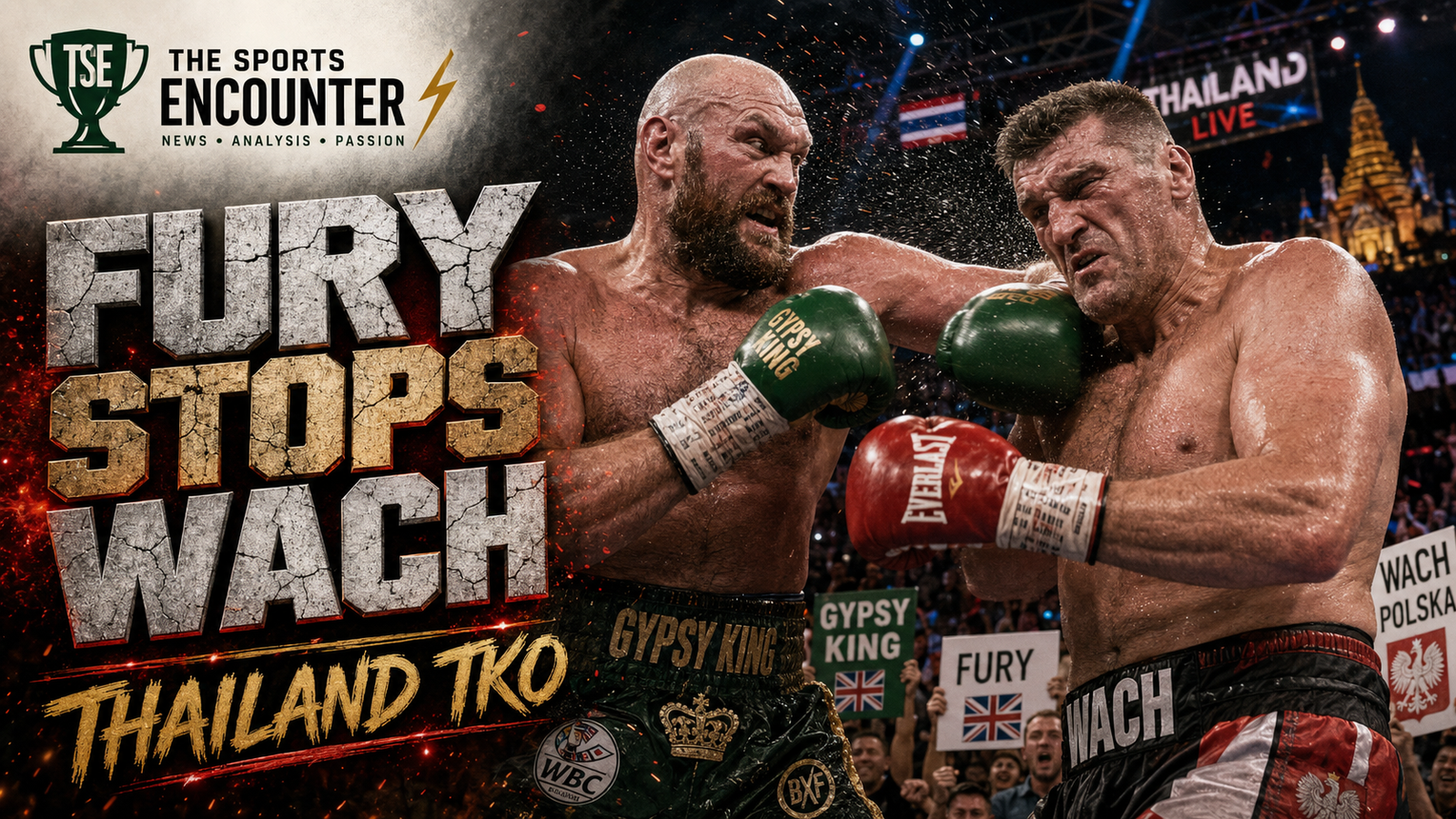
Tyson Fury did what he had to do in Thailand. He won, avoided disaster, banked rounds, and kept the Anthony Joshua fight alive.
The former world heavyweight champion beat Mariusz Wach by seventh-round TKO at the Max Muay Thai Stadium in Pattaya on Friday, after the 46-year-old Polish veteran failed to continue at the start of the eighth round. Reuters reported that the bout was held in front of about 1,500 fans and was not televised live, with footage expected to appear in the Netflix reality series At Home with The Furys.
For Fury, this was never about proving he could beat Wach. That question had almost no suspense. Wach entered as a durable, experienced heavyweight, but also as a fighter deep into the final stretch of his career. The real test was whether Fury could sharpen his timing, stay busy after his April win over Arslanbek Makhmudov, and get through the night without injury, embarrassment, or any result that could damage a long-awaited British heavyweight showdown with Joshua.
He passed that test.
Sky Sports reported that Fury dominated the opening six rounds before Wach signaled toward his corner, with officials ending the contest after the seventh.
Fury vs Wach Key Facts
| Detail | Information |
|---|---|
| Fight | Tyson Fury vs Mariusz Wach |
| Result | Fury won by seventh-round TKO |
| Method | Corner stoppage / Wach retired after round seven |
| Venue | Max Muay Thai Stadium, Pattaya, Thailand |
| Date | July 24, 2026 |
| Fury record after fight | 36-2-1 |
| Wach record after fight | 39-14 |
| Broadcast | No live TV broadcast |
| Crowd | Around 1,500 |
| Main storyline | Fury stayed on course for Anthony Joshua |
| Context | Tune-up fight, charity-linked event, Netflix reality-show footage |
A Controlled Win, With Almost No Drama
Fury controlled the fight through size management, range, switching stance, hand speed, and steady pressure. Sky’s ringside account noted that he moved between orthodox and southpaw, jabbed sharply in the early rounds, and started landing heavier uppercuts by the fifth.
Wach did land a significant reply in the second round, but the broader pattern was clear. Fury was faster, fresher, looser, and able to choose when to press. By round seven, Wach had taken enough punishment for his corner to make the sensible decision.
MMA Fighting listed the official result as Fury defeating Wach by seventh-round TKO through a corner stoppage and noted that the fight was not aired live anywhere.
That lack of live broadcast was central to the strange shape of the event. One of the world’s most recognizable heavyweights fought in Thailand, in a small stadium, away from the usual heavyweight spotlight, with the public largely dependent on reports, highlights, and later documentary footage.
This was modern boxing in its clearest commercial form: part fight, part content asset, part risk-management exercise.
Why This Fight Happened in Thailand
Fury has been training in Thailand as he builds toward the possible Joshua fight. Sky Sports described the Wach bout as a low-risk, low-key tune-up designed to keep Fury active while limiting the chance of derailing the bigger fight.
That is the key to understanding the matchup.
Fury did not need a dangerous contender. He needed rounds. He needed controlled resistance. He needed a professional heavyweight who could stand in front of him, absorb pressure for a while, and give him a night’s work without creating too much chaos.
Wach fit that brief.
He had shared the ring with major heavyweights before, including Wladimir Klitschko, Dillian Whyte, Hughie Fury, and Frazer Clarke. His size, experience, and toughness gave the fight just enough credibility for a tune-up. His age, recent form, and declining sharpness kept the risk low.
Sky reported before the fight that Wach brought a 52-fight record of 39-13 with 20 knockouts into the contest and had lost three of his previous four, including a second-round stoppage loss to Moses Itauma in 2024.
The outcome was therefore less a shock than a confirmation. Fury’s team selected the right level of danger for the moment.
The Weight Detail That Told Its Own Story
Fury weighed in 26 pounds lighter than Wach before the fight, a rare visual twist in a matchup involving the 6-foot-9 British heavyweight. Sky reported that Fury was nearly two stone lighter than the Polish veteran at the weigh-in.
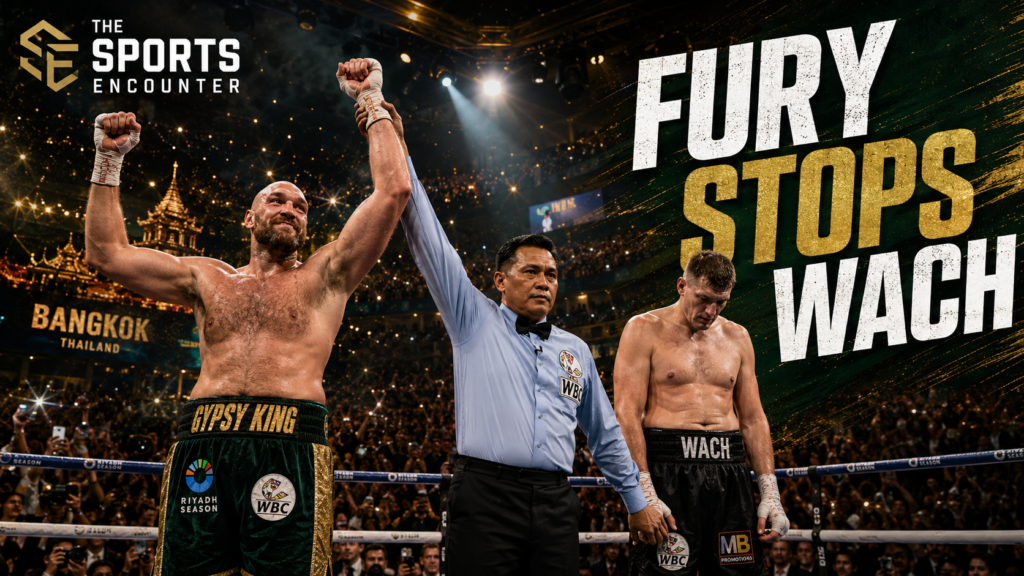
That detail mattered because Fury’s best heavyweight performances have often come when his feet, feints, and rhythm looked clean. Against Wach, he did not need to be perfect. Still, the visible emphasis on movement, stance switching, and hand speed suggested that his camp wanted activity rather than only a quick blast-out.
The result also marked a useful contrast with his April win over Makhmudov, where Fury went the distance and won by unanimous decision. Netflix’s own Tudum coverage listed Fury’s record at 35-2-1 before the Makhmudov fight and described his decision victory over the Russian as a comeback win Netflix Tudum.
The Wach stoppage now gives Fury a cleaner headline. He has two wins in 2026, one decision and one stoppage, after the back-to-back Oleksandr Usyk defeats that changed the shape of his late career.
What Fury Actually Gained
Fury gained three things from this fight.
First, he got rounds. Seven rounds were enough to feel punches coming back, control distance, manage pacing, and reintroduce his body to fight-night rhythm.
Second, he got a stoppage. Even against an aging Wach, stoppages carry value in heavyweight promotion. They allow the Fury-Joshua machine to move forward with sharper language than “comfortable points win.”
Third, he got through safely. That may be the most important point. A cut, injury, knockdown, ugly points struggle, or controversial decision would have complicated everything. Instead, Fury left Thailand with the message his side wanted: one job done, one bigger job waiting.
The Associated Press framed the win simply: Fury got his tune-up out of the way, and now Joshua has to do the same.
That is exactly where the heavyweight story now sits.
The Joshua Fight Is Still the Real Product
Fury used the post-fight moment to turn toward Joshua. Sky Sports reported Fury saying he had passed his own test and would now wait to see whether Joshua could get through his fight against Kristian Prenga in Saudi Arabia.
The language was typically sharp from Fury, but the business logic is even sharper.
Fury-Joshua has been discussed for years. It has survived failed negotiations, changing belts, defeats, comebacks, promotional shifts, and the slow erosion of both fighters’ absolute peak years. At one stage, it would have crowned the best heavyweight in Britain and perhaps the world. Now it carries a different kind of appeal.
It is a legacy fight, a money fight, a cultural event, and a national boxing argument that fans still want settled.
The awkward truth is that both men are managing risk on the way there. Fury took Wach in Thailand. Joshua is scheduled to face Kristian Prenga in Saudi Arabia. Neither matchup is built as a pure sporting test. Both are built as controlled steps toward a bigger event.
That does not make the strategy unusual. Boxing has always used tune-ups. What feels different is the level of visibility around the calculation. Fans know what is happening. Broadcasters know what is happening. Promoters know that fans know.
The suspense is not whether Fury was better than Wach. The suspense is whether boxing can finally deliver Fury vs Joshua before the moment loses its remaining heat.
Wach’s Role Was Thankless but Familiar
Mariusz Wach has made a long career out of being difficult to shift. He has been a measuring stick for heavyweights, a durable opponent who can absorb punishment and force younger or sharper fighters to keep working.
Against Fury, he showed pieces of that old identity. He took jabs, uppercuts, pressure, and body language from a fighter who was never really chasing chaos. The corner stoppage after seven rounds was humane and professional.
At 46, Wach no longer has the mobility or freshness to threaten a fighter of Fury’s class for long. His value lies in experience and physical presence. He gave Fury enough resistance to make the fight useful. That was the job.
Why the Non-TV Element Matters
The strangest part of Fury vs Wach may not be the opponent or the location. It may be the fact that a former world heavyweight champion fought without a live broadcast.
Sky reported before the bout that the fight would not be shown live, although footage was expected to appear in season three of At Home with The Furys.
That turns the fight into a hybrid event. It existed competitively on Friday, but commercially it also exists later, as part of a broader entertainment product. This is where boxing has been heading for years. Fighters are no longer only athletes on fight night. They are documentary subjects, content platforms, social-media brands, and negotiation assets.
For Fury, that structure made sense. He could keep control of the environment, reduce the pressure of a major TV card, support a charity-linked event, and still generate content for Netflix.
For boxing fans, it raises a fair question: when a heavyweight fight matters mainly because of what it protects, is it still a sporting event first or a promotional bridge?
In this case, the answer is somewhere in the middle.
What This Says About Fury’s Late-Career Phase
Fury is no longer in the same career phase as the man who outboxed Wladimir Klitschko in 2015, climbed back from personal crisis, and fought Deontay Wilder across one of the defining heavyweight trilogies of the modern era.
This version of Fury is managing legacy, money, health, public interest, and timing.
The Usyk defeats damaged his aura, but they did not remove his drawing power. The Makhmudov win showed he could still outbox a dangerous heavyweight. The Wach stoppage showed he could still go through a controlled professional assignment without drama.
That is enough for the Joshua story to continue.
It may not be enough to convince everyone he remains at the top of the heavyweight division. Those are separate questions now. Fury against the elite heavyweights is one conversation. Fury against Joshua as a British sporting event is another.
Verdict: Job Done, Bigger Test Waiting
Fury’s win over Wach will not be remembered as a major heavyweight result. It should not be dressed up as one.
Still, it served its purpose. Fury got seven rounds, forced a stoppage, avoided damage, and kept pressure on Joshua. Wach gave him the kind of durable, low-risk work his team clearly wanted. Thailand provided the controlled setting. Netflix gets its footage. The Joshua fight gets another promotional push.
The real verdict will come only if Joshua also wins and the long-promised all-British fight finally moves from fantasy to signed reality.
For now, Fury has handled his side of the bargain.
The Sports Encounter’s combat-sports coverage will continue tracking Fury, Joshua, and the heavyweight division as boxing’s biggest delayed domestic rivalry moves toward its next decision point.
FAQs
Who won Tyson Fury vs Mariusz Wach in Thailand?
Tyson Fury beat Mariusz Wach by seventh-round TKO in Pattaya, Thailand.
How did Tyson Fury beat Mariusz Wach?
Fury controlled the fight before Wach’s corner stopped the bout after the seventh round.
Where did Tyson Fury vs Mariusz Wach take place?
The fight took place at Max Muay Thai Stadium in Pattaya, Thailand.
Was Tyson Fury vs Mariusz Wach shown live on TV?
The fight was not televised live, though footage is expected to be used in At Home with The Furys.
What is Tyson Fury’s record after beating Mariusz Wach?
Fury’s professional record moved to 36 wins, 2 losses, and 1 draw.
Why did Tyson Fury fight Mariusz Wach?
The bout worked as a tune-up fight to keep Fury active before a possible heavyweight showdown with Anthony Joshua.
Is Tyson Fury fighting Anthony Joshua next?
Fury remains on course for a possible fight with Anthony Joshua, but Joshua still has to get through his own scheduled bout first.
What was Mariusz Wach’s record after the fight?
Wach’s record fell to 39 wins and 14 losses after the defeat.