


Sahan Arachchige gave Galle Gallants the innings they needed. Tharindu Ratnayake gave them the spell that broke Jaffna Kings. Dunith Wellalage gave Jaffna the only real resistance they could hold onto.
Everything else around the Kings felt fragile.
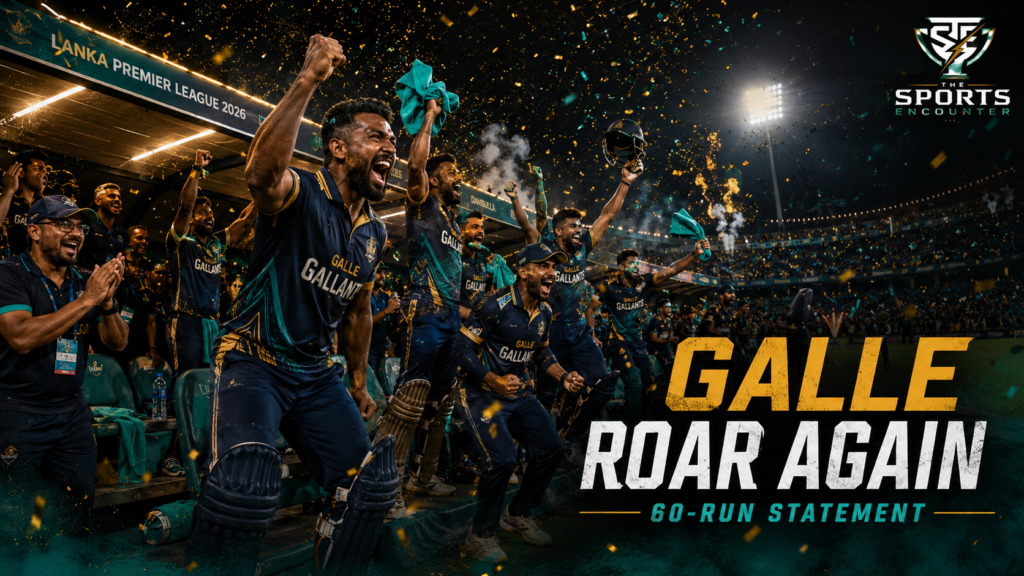
On a night when Galle reclaimed control of their Lanka Premier League 2026 campaign with a commanding 60-run win at Rangiri Dambulla International Stadium, Jaffna’s defeat carried more weight than the scorecard alone. Their chase never settled, their fielding let pressure slip, and their off-field ownership crisis deepened the sense that this was a team trying to play cricket while the ground underneath it was shifting.
Galle made 193 for 8 after being asked to bat first. Jaffna were bowled out for 133 in 17.5 overs. The margin gave the Gallants a major net run rate boost and pushed them back to the top of the table.
It also left Jaffna in a dangerous place.
As one fan, Akindu, summed up during the match: “Kings are gonna be in a bad place NRR-wise if they’re not careful.”
He was right.
Match Summary
| Match detail | Information |
|---|---|
| Competition | Lanka Premier League 2026 |
| Match | Galle Gallants vs Jaffna Kings, Match 10 |
| Venue | Rangiri Dambulla International Stadium |
| Date | July 23, 2026 |
| Toss | Jaffna Kings elected to field |
| Galle Gallants | 193/8 in 20 overs |
| Jaffna Kings | 133 all out in 17.5 overs |
| Result | Galle Gallants won by 60 runs |
| Top scorer | Sahan Arachchige, 63 off 36 |
| Best bowling | Tharindu Ratnayake, 3/19 |
| Key support spell | Eshan Malinga, 3/13 |
| Jaffna resistance | Dunith Wellalage, 56 off 39 |
Arachchige Turns a Shaky Start Into a Winning Total
Galle’s innings did not begin like a 193-run statement.
Sam Harper was bowled by Dunith Wellalage for 3. Charith Asalanka, who had already played a major role in Galle’s opening win over Jaffna Kings, fell for 6. At 16 for 2 after three overs, Jaffna had given themselves the start they wanted.
Chris Lynn changed the tempo before the Kings could own the powerplay.
Lynn smashed 46 from 22 balls, hitting three fours and four sixes. His strike rate of 209.09 kept Galle ahead of the game even as wickets fell. When Lizaad Williams removed him in the eighth over, Galle had reached 64, but the next wicket came almost immediately as Chamika Karunaratne fell for 9.
Galle were 65 for 4. Jaffna had another opening.
Arachchige then took the game away with the calm of a batter who understood both the scoreboard and the moment. His 63 from 36 balls included four fours and three sixes, but the value of the innings was not only in the boundaries. He absorbed pressure, carried Galle through the middle overs, and then helped turn a competitive total into a match-winning one.
Dasun Shanaka made 12 before Shakib Al Hasan dismissed him. Dinura Kalupahana added 10. At 110 for 6 in the 15th over, Jaffna were still alive.
Mohammad Nawaz changed that.
His 27 from 16 balls, with two fours and two sixes, gave Galle the late acceleration they needed. The Arachchige-Nawaz partnership lifted Galle from 110 for 6 to 178 for 7. Vijayakanth Viyaskanth then finished unbeaten on 6 from two balls as Galle closed on 193 for 8.
It was another strong Galle batting performance in a tournament where totals near 190 have become decisive. Their 193 followed the 213 they made in the opener, Colombo Kaps’ 192 in their Match 9 victory over Kandy Royals, and Kandy’s 194 in their 43-run win over Dambulla Sixers.
Jaffna Create Pressure but Fail to Hold It
Jaffna’s bowling card carried contradictions.
Wellalage was outstanding with 1 for 13 from three overs. Mohamed Shiraz took 1 for 23. Dilshan Madushanka and Lizaad Williams picked up two wickets each. Those numbers should have kept Galle closer to 165 than 193.
The problem came from the overs that leaked.
Traveen Mathew’s three overs went for 54. Shakib’s three cost 27. Williams took wickets but conceded 37 from four. Every time Jaffna created pressure, Galle found a release point.
That inability to hold control became the theme of the night.
Bhanuka Rajapaksa admitted as much afterward.
“[Four dropped catches] Yeah, it’s a bit difficult because I think, as you said, until the 17th over, we were very well in control of the game. But these things happen, and we just need to learn from the mistakes that we made. It is a long tournament, so we can’t keep repeating them.
“[Momentum shift during the innings break] I think everyone should believe in momentum. Credit should go to the opposition batters who scored about 80 runs in the last four overs. When the momentum shifts towards the opposition, it is very difficult to gather it back. As I said before, hopefully we learn from it and look forward to the next game.”
That quote captured Jaffna’s night perfectly. They were in the match. Then they lost the match before the chase had even settled.
Jaffna’s Chase Breaks Inside the Powerplay
A target of 194 required intent, but Jaffna needed controlled aggression. Instead, they got early chaos.
Avishka Fernando was dropped on naught by Viyaskanth, but Galle were not punished for the mistake. Fernando hit a six and then threw his wicket away in the same over, caught by Eshan Malinga off Shanaka for 6.
Ratnayake then landed the double blow that defined the chase. Kamil Mishara fell for 15 from eight balls, and Shakib was bowled next ball for a golden duck.
Jaffna were 24 for 3 after 2.3 overs.
Rajapaksa hit two boundaries in his brief stay, but Akif Javed removed him for 8. Ibrahim Zadran struggled for rhythm and made 11 from 14 before Malinga dismissed him.
At 50 for 5 after 6.2 overs, Jaffna’s top order had failed. The required rate was climbing, the wickets were gone, and the innings had lost its structure.
This was a sharp contrast with Jaffna’s earlier tournament wins, especially their five-wicket victory over Dambulla Sixers and their narrow five-run win over Colombo Kaps. In those games, someone found a way to drag Jaffna through pressure. Here, only Wellalage stood up for long enough.
Wellalage Plays a Lone Hand
Wellalage’s 56 from 39 balls deserved a better chase around it.
He reached his half-century from 37 deliveries, striking four fours and four sixes. His partnership with David Wiese gave Jaffna a small glimmer of hope, adding 39 runs after the early collapse. Wiese made 22 from 20 before Ratnayake had him caught at long-off in the 11th over.
That wicket closed the last realistic door.
Chamindu Wickramasinghe made 6. Traveen Mathew was bowled first ball. Both fell to Malinga in the 13th over, leaving Jaffna 99 for 8.
Wellalage kept swinging, partly for pride and partly for net run rate. He was eventually the last batter to fall, caught off Viyaskanth for 56. Lizaad Williams was absent hurt, so Jaffna were all out for 133 in 17.5 overs.
It was a brave innings in a broken chase.
Ratnayake and Malinga Do the Damage
Galle’s bowling response was clinical.
Ratnayake finished with 3 for 19 from four overs and bowled 14 dot balls. His wickets of Mishara, Shakib, and Wiese destroyed the top and middle phases of the chase.
Malinga was even tighter, taking 3 for 13 from three overs. He removed Zadran, Wickramasinghe, and Mathew, giving Galle control every time Jaffna looked for a restart.
Akif Javed’s 1 for 22 from four overs was also important. He bowled 15 dot balls and removed Rajapaksa, a wicket that mattered because Jaffna’s captain was the one player capable of changing the emotional direction of the chase quickly.
Galle’s fielding was imperfect. They dropped chances and misfielded too often. Yet the bowlers kept creating enough pressure to make those mistakes survivable.
That was the biggest difference between the two teams. Jaffna’s mistakes opened the game for Galle. Galle’s mistakes only delayed the inevitable.
Jaffna’s Defeat Lands on a Day of Franchise Turmoil
Jaffna’s problems did not end with the result.
On the same day, ESPNcricinfo reported that Innovative Production Group, the rights holder of the Lanka Premier League, and Sri Lanka Cricket had officially terminated their franchise agreement with Sports Commune, stripping the company of Jaffna Kings ownership.
The reason was financial.
IPG said the termination followed the franchisee’s “inability to fulfil its financial obligations” under the franchise agreement. All rights relating to Jaffna Kings have now reverted to IPG, which, together with Sri Lanka Cricket, has assumed full operational control of the team.
The move followed the arrest of Jaffna Kings co-owner Manjot Kalra, who remains in judicial custody until July 31. According to the report, the franchise’s commercial structure required sponsors to pay the owners directly, with the owners then responsible for distributing salaries to players and staff. That pipeline broke down after Kalra’s arrest.
The situation became visible during Jaffna’s July 22 match, when players reportedly took the field with black tape covering sponsor logos on their jerseys because Sports Commune had failed to distribute sponsorship funds.
IPG and SLC have now taken over player, coaching, and support-staff contracts. Emergency funds have reportedly cleared around 90% of outstanding player and staff salaries, with IPG committing to settle the remaining balances according to contractual timelines.
IPG also confirmed that the sixth edition of the LPL will continue as scheduled and that Jaffna Kings will keep participating under the same name, with no changes to the squad, tournament format, or match schedule.
IPG CEO Anil Mohan said the priority was to protect the integrity of the league and provide stability for players, coaches, partners, and fans.
That context matters because teams do not operate in emotional isolation. Players can say they focus only on cricket, but uncertainty around ownership, salaries, sponsors, and public scrutiny does not disappear at the boundary rope.
Against Galle, Jaffna looked like a side carrying too much. Their early wickets, fielding lapses, and loss of control after the 17th over all fit into a wider picture of instability.
Why This Win Matters for Galle
Galle had lost momentum after Dambulla Sixers beat them in Match 8, a result shaped by Reeza Hendricks’ composed chase in Dambulla’s win over Galle Gallants.
This response was exactly what they needed.
Arachchige proved Galle can recover from top-order damage. Nawaz showed the lower middle order can add impact at the death. Ratnayake and Malinga gave the bowling attack wicket-taking authority. The 60-run margin repaired their net run rate and restored their position at the top.
The Gallants are beginning to look like the most complete side in the tournament. They have power at the top, flexibility in the middle, and enough bowling variety to attack different phases.
Their first win over Jaffna was built on batting dominance. This one was built on recovery, late acceleration, and bowling pressure. That range matters in a tournament where conditions, matchups, and momentum keep changing quickly.
Official fixtures, standings, and tournament updates are available through the Lanka Premier League’s official website.
LPL 2026 Points Table After Match 10
| Position | Team | Played | Won | Lost | No result | NRR | Points |
|---|---|---|---|---|---|---|---|
| 1 | Galle Gallants | 4 | 3 | 1 | 0 | +0.854 | 6 |
| 2 | Colombo Kaps | 4 | 2 | 2 | 0 | +0.201 | 4 |
| 3 | Dambulla Sixers | 4 | 2 | 2 | 0 | -0.016 | 4 |
| 4 | Jaffna Kings | 4 | 2 | 2 | 0 | -1.002 | 4 |
| 5 | Kandy Royals | 4 | 1 | 3 | 0 | -0.051 | 2 |
Note: Table order is based on points first, then net run rate. Jaffna remain on four points but drop below Colombo Kaps and Dambulla Sixers because of their weaker NRR.
Final Verdict
Galle Gallants did not play a perfect match, but they played the decisive moments far better.
Arachchige held the innings together. Nawaz gave it late power. Ratnayake and Malinga then ripped through Jaffna’s chase before it could form a spine.
Jaffna had Wellalage’s courage, but not enough support. Rajapaksa’s honesty after the match was important because he identified the real issue: Jaffna had control, lost momentum, and failed to win it back.
The cricketing damage is clear. A 60-run defeat has pushed their net run rate into dangerous territory. The off-field damage is more complicated, with ownership control now shifting to IPG and Sri Lanka Cricket after Sports Commune’s termination.
For Galle, this was a top-of-the-table statement. For Jaffna, it was a night where the scorecard, the table, and the franchise news all pointed in the same uncomfortable direction.
FAQs
Who won the Galle Gallants vs Jaffna Kings LPL 2026 match?
Galle Gallants beat Jaffna Kings by 60 runs in Match 10 of the Lanka Premier League 2026.
Who was the top scorer in Galle Gallants vs Jaffna Kings Match 10?
Sahan Arachchige was the top scorer, making 63 from 36 balls for Galle Gallants.
Who took the most wickets for Galle Gallants?
Tharindu Ratnayake and Eshan Malinga took three wickets each. Ratnayake finished with 3 for 19, while Malinga took 3 for 13.
How many runs did Dunith Wellalage score?
Dunith Wellalage scored 56 from 39 balls for Jaffna Kings, but he lacked support during the chase.
What happened to Jaffna Kings ownership?
IPG and Sri Lanka Cricket terminated Sports Commune’s franchise agreement after the ownership group failed to meet financial obligations. Jaffna Kings will continue in LPL 2026 under the same name, with IPG and SLC taking operational control.