


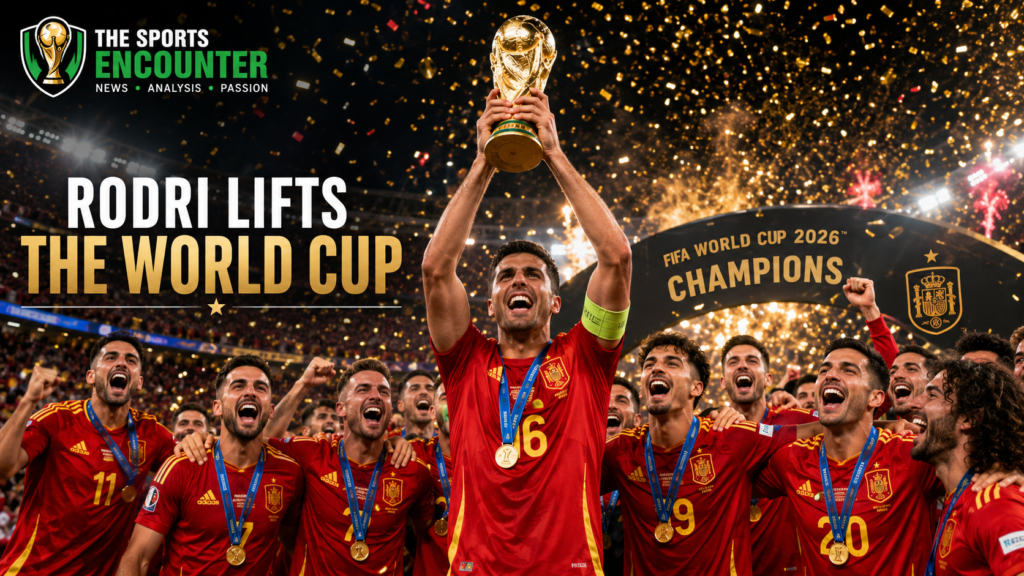
Rodri won the FIFA World Cup 2026 Golden Ball because he controlled the part of the game that decided Spain’s championship: the space between defending and attacking.
Kylian Mbappé scored 10 goals. Lionel Messi led Argentina back to the final. Lamine Yamal provided Spain with imagination, width, and youthful nerve. Yet when FIFA selected the Player of the Tournament, the award went to the man who gave every part of Spain’s football its balance.
Rodri, Spain’s captain and midfield anchor, received the adidas Golden Ball after La Roja defeated Argentina 1-0 following extra time in the final at New York New Jersey Stadium. His tournament was built on control rather than highlight-reel production. He moved the ball, protected the defense, managed transitions, organized teammates, and repeatedly made difficult matches feel comfortable for Spain.
For supporters asking why Rodri won the 2026 World Cup Golden Ball, the clearest answer lies in his total influence. He was Spain’s tactical reference point across all eight matches.
Why Did Rodri Win the FIFA World Cup 2026 Golden Ball?
FIFA highlighted Rodri’s ability to connect defense with attack, intervene at the right moments, and pass with exceptional accuracy. Those qualities shaped Spain’s entire campaign.
Rodri completed more passes than any other player at the tournament. He finished with 655 accurate passes from 705 attempts, giving him a completion rate of almost 93 percent. His distribution remained accurate even when he advanced the ball into crowded attacking areas.
The numbers describe only part of his value. Spain trusted Rodri to receive possession under pressure, turn away from opponents, and decide whether the next action required patience or speed. He rarely forced the game. His decisions allowed Pedri, Fabián Ruiz, Dani Olmo, Nico Williams, and Yamal to operate with greater freedom.
During Spain’s World Cup final victory over Argentina, Rodri completed 101 of his 105 passes. He also won 80 percent of his duels and created two scoring chances. Those figures came in the highest-pressure match of the tournament, against a team built to punish mistakes and disrupt central midfield rhythm.
Rodri Controlled the World Cup Final Against Argentina
The final offered the strongest explanation for FIFA’s decision.
Argentina entered the match with Messi operating between midfield and attack, Enzo Fernández attempting to progress the ball, and Lautaro Martínez looking for opportunities behind Spain’s defense. Rodri’s positioning reduced the space available to all three.
He rarely chased Messi recklessly. Instead, Rodri stayed connected to Spain’s center backs, blocked forward passing lanes, and moved across the field as Argentina changed the point of attack. When Messi dropped deeper, Rodri helped prevent him from turning into open space.
One of his most important interventions came late in the contest when he dispossessed Messi during a dangerous Argentine transition. It was the kind of moment that defined Rodri’s tournament. The action did not produce a goal or assist, but it stopped Argentina from creating the moment that could have changed the final.
Spain eventually broke through when Ferran Torres scored in the 106th minute. The goal earned the headlines. Rodri had spent the previous 105 minutes ensuring Spain remained in control long enough for the breakthrough to arrive.
Spain’s Defensive Record Strengthened Rodri’s Case
Spain conceded only one goal across eight World Cup matches. That record belonged to the entire team, including Golden Glove winner Unai Simón and a disciplined defense led by Pau Cubarsí and Aymeric Laporte.
Rodri provided the protection in front of them.
He led the tournament with 26 tackles and won 63.3 percent of his ground duels. Spain’s opponents produced only 2.37 expected goals across the competition, a remarkably low figure for an eight-match run through an expanded World Cup.
His defensive intelligence was especially valuable because Spain committed numbers forward. Fullbacks advanced, wide attackers stayed high, and midfielders moved between the lines. Rodri monitored the spaces they left behind and slowed counterattacks before they developed into clear chances.
That structure helped Spain eliminate Austria, Portugal, Belgium, France, and Argentina during the knockout stage. The 2-0 semifinal victory over France offered another example. Mbappé and Ousmane Dembélé entered as major attacking threats, but Spain controlled the center and denied France the transitions they needed.
Rodri Gave Spain More Than Passing Accuracy
Defensive midfielders are often judged through pass-completion percentages, but safe passing alone does not explain Rodri’s importance.
His value came from choosing the right pass at the right moment.
Rodri could recycle possession when Spain needed stability, break the first defensive line with a vertical pass, switch play toward Yamal or Williams, or draw an opponent forward before releasing a teammate into the space behind him.
He completed more final-third passes than any other player and maintained an accuracy rate above 90 percent in advanced areas. That distinction matters. Passing accurately near one’s own defense is far easier than finding teammates around a compact penalty area.
Spain experienced the difficulty of breaking down deep defenses during their opening goalless draw with Cape Verde. As the competition progressed, Rodri helped Spain improve the speed and direction of their possession. La Roja became more purposeful without losing control.
Was Rodri Better Than Messi and Mbappé at World Cup 2026?
That question depends on how tournament excellence is measured.
Mbappé was the outstanding goalscorer and deserved the Golden Boot after scoring 10 times. Messi remained Argentina’s attacking leader and received the Silver Ball after guiding the defending champions to another final.
Rodri influenced more phases of the game.
He contributed to Spain’s buildup, defensive organization, pressing structure, game management, and leadership. While Mbappé decided matches near the penalty area and Messi created Argentina’s most dangerous moments, Rodri shaped how Spain played from the opening pass to the final defensive action.
Before the final, The Sports Encounter’s ranking of the top players at the FIFA World Cup 2026 reflected how difficult it was to compare goalscorers with midfield controllers. The final strengthened Rodri’s argument because he delivered his most complete performance on the tournament’s biggest night.
Rodri’s Leadership Mattered During Spain’s Title Run
Rodri also carried the captaincy during a campaign that required Spain to manage different kinds of pressure.
The team began with questions after drawing against Cape Verde. It responded by beating Saudi Arabia 4-0 and Uruguay 1-0 before finding a stronger rhythm in the knockout rounds.
Spain then defeated Austria 3-0, eliminated Portugal 1-0, overcame Belgium 2-1, shut out France 2-0, and finally defeated Argentina.
Rodri gave the side emotional stability throughout those changes. He communicated constantly, slowed matches when opponents gained momentum, and helped younger players remain connected to Spain’s structure.
Yamal, Cubarsí, and several other members of the squad experienced their first World Cup under intense expectations. Rodri’s calm authority gave Luis de la Fuente an experienced leader in the most important area of the pitch.
Why Rodri Was the Right FIFA World Cup 2026 Player of the Tournament
Golden Ball debates often favor goals, assists, and individual attacking moments. Rodri’s victory recognized a broader form of football influence.
He completed the most passes, maintained elite accuracy, won tackles and duels, protected the tournament’s best defense, controlled the final, and captained Spain to its second world championship.
FIFA’s choice reflected the story of the tournament. Spain won through collective intelligence, positional discipline, technical quality, and patience. Rodri embodied every one of those qualities.
Ferran Torres scored the goal that won the final. Unai Simón protected Spain’s net. Yamal supplied invention, while Cubarsí represented the team’s emerging generation.
Rodri made the entire system function.
Frequently Asked Questions
Who won the FIFA World Cup 2026 Golden Ball?
Spain captain Rodri won the adidas Golden Ball as the best player of the FIFA World Cup 2026.
Why did Rodri win Player of the Tournament?
Rodri won because of his passing accuracy, defensive work, midfield control, leadership, consistency, and major influence during Spain’s championship campaign.
What were Rodri’s statistics in the 2026 World Cup final?
Rodri completed 101 of 105 passes, won 80 percent of his duels, and created two chances against Argentina.
Who finished behind Rodri in the Golden Ball voting?
Lionel Messi received the Silver Ball, while Kylian Mbappé received the Bronze Ball and also won the Golden Boot.
How many goals did Spain concede at the 2026 World Cup?
Spain conceded only one goal across eight matches, with Rodri playing a central role in protecting the defense.
The Sports Encounter’s World Cup 2026 coverage focuses on fixtures, team news, match analysis, fan stories, tournament trends, and the biggest talking points from football’s global stage.